Over the first 23 years of this century, the Linux operating system has become as ubiquitous as Windows. Although only 3% of people use it on their laptops and PCs, Linux dominates the Internet of Things, and is also the most popular server OS. You almost certainly have at least one Linux device at home — your Wi-Fi show more ...
router. But its highly likely there are actually many more: Linux is often used in smart doorbells, security cameras, baby monitors, network-attached storage (NAS), TVs, and so on. At the same time, Linux has always had a reputation of being a trouble-free OS that requires no special maintenance and is of no interest to hackers. Unfortunately, neither of these things is true of Linux anymore. So what are the threats faced by home Linux devices? Lets consider three practical examples. Router botnet By running malware on a router, security camera, or some other device thats always on and connected to the internet, attackers can exploit it for various cyberattacks. The use of such bots is very popular in DDoS attacks. A textbook case was the Mirai botnet, used to launch the largest DDoS attacks of the past decade. Another popular use of infected routers is running a proxy server on them. Through such a proxy, criminals can access the internet using the victims IP address and cover their tracks. Both of these services are constantly in demand in the cybercrime world, so botnet operators resell them to other cybercriminals. NAS ransomware Major cyberattacks on large companies with subsequent ransom demands — that is, ransomware attacks, have made us almost forget that this underground industry started with very small threats to individual users. Encrypting your computer and demanding a hundred dollars for decryption — remember that? In a slightly modified form, this threat re-emerged in 2021 and evolved in 2022 — but now hackers are targeting not laptops and desktops, but home file servers and NAS. At least twice, malware has attacked owners of QNAP NAS devices (Qlocker, Deadbolt). Devices from Synology, LG, and ZyXEL faced attacks as well. The scenario is the same in all cases: attackers hack publicly accessible network storage via the internet by brute-forcing passwords or exploiting vulnerabilities in its software. Then they run Linux malware that encrypts all the data and presents a ransom demand. Spying on desktops Owners of desktop or laptop computers running Ubuntu, Mint, or other Linux distributions should also be wary. Desktop malware for Linux has been around for a long time, and now you can even encounter it on official websites. Just recently, we discovered an attack in which some users of the Linux version of Free Download Manager (FDM) were being redirected to a malicious repository, where they downloaded a trojanized version of FDM onto their computers. To pull off this trick, the attackers hacked into the FDM website and injected a script that randomly redirected some visitors to the official, clean version of FDM, and others to the infected one. The trojanized version deployed malware on the computer, stealing passwords and other sensitive information. There have been similar incidents in the past, for example, with Linux Mint images. Its important to note that vulnerabilities in Linux and popular Linux applications are regularly discovered (heres a list just for the Linux kernel). Therefore, even correctly configured OS tools and access roles dont provide complete protection against such attacks. Basically, its no longer advisable to rely on widespread beliefs such as Linux is less popular and not targeted, I dont visit suspicious websites, or just dont work as a root user. Protection for Linux-based workstations must be as thorough as for Windows and MacOS ones. How to protect Linux systems at home Set a strong administrator password for your router, NAS, baby monitor, and home computers. The passwords for these devices must be unique. Brute forcing passwords and trying default factory passwords remain popular methods of attacking home Linux. Its a good idea to store strong (long and complex) passwords in a password manager so you dont have to type them in manually each time. Update the firmware of your router, NAS, and other devices regularly. Look for an automatic update feature in the settings — thats very handy here. These updates will protect against common attacks that exploit vulnerabilities in Linux devices. Disable Web access to the control panel. Most routers and NAS devices allow you to restrict access to their control panel. Ensure your devices cannot be accessed from the internet and are only available from the home network. Minimize unnecessary services. NAS devices, routers, and even smart doorbells function as miniature servers. They often include additional features like media hosting, FTP file access, printer connections for any home computer, and command-line control over SSH. Keep only the functions you actually use enabled. Consider limiting cloud functionality. If you dont use the cloud functions of your NAS (such as WD My Cloud) or can do without them, its best to disable them entirely and access your NAS only over your local home network. Not only will this prevent many cyberattacks, but it will also safeguard you against incidents on the manufacturers side. Use specialized security tools. Depending on the device, the names and functions of available tools may vary. For Linux PCs and laptops, as well as some NAS devices, antivirus solutions are available, including regularly updated open-source options like ClamAV. There are also tools for more specific tasks, such as rootkit detection. For desktop computers, consider switching to the Qubes operating system. Its built entirely on the principles of containerization, allowing you to completely isolate applications from each other. Qubes containers are based on Fedora and Debian.
The victim shaming site operated by the Snatch ransomware group is leaking data about its true online location and internal operations, as well as the Internet addresses of its visitors, KrebsOnSecurity has found. The leaked data suggest that Snatch is one of several ransomware groups using paid ads on Google.com to show more ...
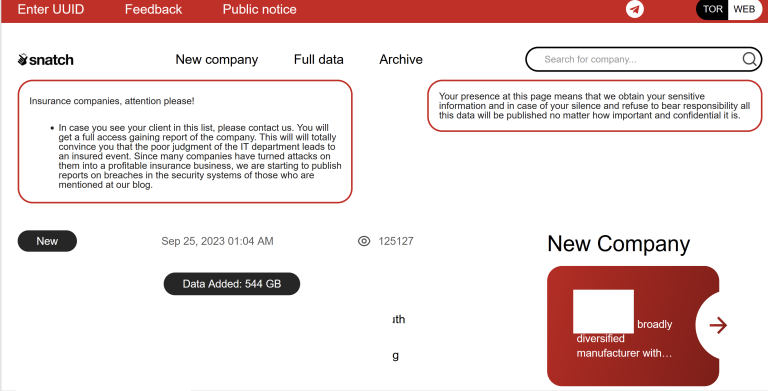
trick people into installing malware disguised as popular free software, such as Microsoft Teams, Adobe Reader, Mozilla Thunderbird, and Discord. First spotted in 2018, the Snatch ransomware group has published data stolen from hundreds of organizations that refused to pay a ransom demand. Snatch publishes its stolen data at a website on the open Internet, and that content is mirrored on the Snatch team’s darknet site, which is only reachable using the global anonymity network Tor. The victim shaming website for the Snatch ransomware gang. KrebsOnSecurity has learned that Snatch’s darknet site exposes its “server status” page, which includes information about the true Internet addresses of users accessing the website. Refreshing this page every few seconds shows that the Snatch darknet site generates a decent amount of traffic, often attracting thousands of visitors each day. But by far the most frequent repeat visitors are coming from Internet addresses in Russia that either currently host Snatch’s clear web domain names or recently did. The Snatch ransomware gang’s victim shaming site on the darknet is leaking data about its visitors. This “server status” page says that Snatch’s website is on Central European Summer Time (CEST) and is powered by OpenSSL/1.1.1f, which is no longer supported by security updates. Probably the most active Internet address accessing Snatch’s darknet site is 193.108.114[.]41, which is a server in Yekaterinburg, Russia that hosts several Snatch domains, including snatchteam[.]top, sntech2ch[.]top, dwhyj2[.]top and sn76930193ch[.]top. It could well be that this Internet address is showing up frequently because Snatch’s clear-web site features a toggle button at the top that lets visitors switch over to accessing the site via Tor. Another Internet address that showed up frequently in the Snatch server status page was 194.168.175[.]226, currently assigned to Matrix Telekom in Russia. According to DomainTools.com, this address also hosts or else recently hosted the usual coterie of Snatch domains, as well as quite a few domains phishing known brands such as Amazon and Cashapp. The Moscow Internet address 80.66.64[.]15 accessed the Snatch darknet site all day long, and that address also housed the appropriate Snatch clear-web domains. More interestingly, that address is home to multiple recent domains that appear confusingly similar to known software companies, including libreoff1ce[.]com and www-discord[.]com. This is interesting because the phishing domains associated with the Snatch ransomware gang were all registered to the same Russian name — Mihail Kolesnikov, a name that is somewhat synonymous with recent phishing domains tied to malicious Google ads. Kolesnikov could be a nod to a Russian general made famous during Boris Yeltsin’s reign. Either way, it’s clearly a pseudonym, but there are some other commonalities among these domains that may provide insight into how Snatch and other ransomware groups are sourcing their victims. DomainTools says there are more than 1,300 current and former domain names registered to Mihail Kolesnikov between 2013 and July 2023. About half of the domains appear to be older websites advertising female escort services in major cities around the United States (e.g. the now-defunct pittsburghcitygirls[.]com). The other half of the Kolesnikov websites are far more recent phishing domains mostly ending in “.top” and “.app” that appear designed to mimic the domains of major software companies, including www-citrix[.]top, www-microsofteams[.]top, www-fortinet[.]top, ibreoffice[.]top, www-docker[.]top, www-basecamp[.]top, ccleaner-cdn[.]top, adobeusa[.]top, and www.real-vnc[.]top. In August 2023, researchers with Trustwave Spiderlabs said they encountered domains registered to Mihail Kolesnikov being used to disseminate the Rilide information stealer trojan. But it appears multiple crime groups may be using these domains to phish people and disseminate all kinds of information-stealing malware. In February 2023, Spamhaus warned of a huge surge in malicious ads that were hijacking search results in Google.com, and being used to distribute at least five different families of information stealing trojans, including AuroraStealer, IcedID/Bokbot, Meta Stealer, RedLine Stealer and Vidar. For example, Spamhaus said victims of these malicious ads would search for Microsoft Teams in Google.com, and the search engine would often return a paid ad spoofing Microsoft or Microsoft Teams as the first result — above all other results. The malicious ad would include a logo for Microsoft and at first glance appear to be a safe and trusted place to download the Microsoft Teams client. However, anyone who clicked on the result was whisked away instead to mlcrosofteams-us[.]top — yet another malicious domain registered to Mr. Kolesnikov. And while visitors to this website may believe they are only downloading the Microsoft Teams client, the installer file includes a copy of the IcedID malware, which is really good at stealing passwords and authentication tokens from the victim’s web browser. Image: Spamhaus The founder of the Swiss anti-abuse website abuse.ch told Spamhaus it is likely that some cybercriminals have started to sell “malvertising as a service” on the dark web, and that there is a great deal of demand for this service. In other words, someone appears to have built a very profitable business churning out and promoting new software-themed phishing domains and selling that as a service to other cybercriminals. Or perhaps they are simply selling any stolen data (and any corporate access) to active and hungry ransomware group affiliates. The tip about the exposed “server status” page on the Snatch darkweb site came from @htmalgae, the same security researcher who alerted KrebsOnSecurity earlier this month that the darknet victim shaming site run by the 8Base ransomware gang was inadvertently left in development mode. That oversight revealed not only the true Internet address of the hidden 8Base site (in Russia, naturally), but also the identity of a programmer in Moldova who apparently helped to develop the 8Base code. @htmalgae said the idea of a ransomware group’s victim shaming site leaking data that they did not intend to expose is deliciously ironic. “This is a criminal group that shames others for not protecting user data,” @htmalgae said. “And here they are leaking their user data.” All of the malware mentioned in this story is designed to run on Microsoft Windows devices. But Malwarebytes recently covered the emergence of a Mac-based information stealer trojan called AtomicStealer that was being advertised through malicious Google ads and domains that were confusingly similar to software brands. Please be extra careful when you are searching online for popular software titles. Cracked, pirated copies of major software titles are a frequent source of infostealer infections, as are these rogue ads masquerading as search results. Make sure to double-check you are actually at the domain you believe you’re visiting *before* you download and install anything. Stay tuned for Part II of this post, which includes a closer look at the Snatch ransomware group and their founder. Further reading: @HTMalgae’s list of the top Internet addresses seen accessing Snatch’s darknet site Ars Technica: Until Further Notice Think Twice Before Using Google to Download Software Bleeping Computer: Hackers Abuse Google Ads to Spread Malware in Legit Software
The US government aims to support open source projects, while the European Union seeks to make open source projects liable for their software. Which approach will lead to more security?
A new Xenomorph malware campaign was detected in August 2023. It appears to have widened its target scope, including financial institutions and crypto-wallet apps, with each sample aiming at over 100 different targets. This Android malware leverages its Automated Transfer System for versatile actions based on specific conditions. With the emergence of this variant, researchers anticipate more attacks in the future.
The complainant alleges that ChatGPT generated false information about them and that OpenAI failed to address their concerns regarding the processing of their personal data, violating GDPR requirements.
The PQC Coalition features Microsoft, IBM Quantum, MITRE, PQShield, SandboxAQ, and the University of Waterloo among its founding members. The goal will be to improve the uptake of PQC in commercial and open-source technologies.
The majority of the leaked files seem to originate from servers associated with Creators Cloud, and the hackers have not provided evidence that all Sony systems have been compromised.
Microsoft updated Windows 11 on Tuesday to simplify passwordless adoption, protect against malicious code, and have the ability to refresh configuration in the event of tampering.
The vulnerability in libwebp, which stems from an issue in the Huffman coding algorithm, can result in out-of-bounds data writing to the heap when processing specially crafted WebP lossless files.
The cyberattack on the entity on October 2, 2022, resulted in about $160 million in damages, including lost revenue, remediation costs, and related expenses, not counting insurance recoveries, according to CommonSpirit.
The ZeroFont phishing technique exploits flaws in AI and natural language processing systems to insert hidden words or characters in emails, evading security filters and tricking recipients.
The group's malware includes trojans named DangerAds and AtlasAgent, with AtlasAgent being a custom C++ trojan that can execute various commands and evade detection by security tools.
Ukrainian cyber defenders are girding for an onslaught of cyberattacks against energy and other critical infrastructure sectors as cold weather returns to the country, currently in its second year of fending off a Russian war of conquest.
The Philippine Health Insurance Corporation (PhilHealth), which manages the country's universal healthcare system, has been hit by a ransomware attack. The incident forced the organization to shut down several websites and portals.
Pension providers reported a staggering quadruple-digit percentage increase in data breaches to the UK regulator last year, according to new data compiled by professional services firm RPC.
The attack affected key systems and financial information, making it difficult for the company to secure investment and funding, ultimately leading to job losses for hundreds of employees.
A global survey by Keeper Security highlighted the shortcomings in reporting cyberattacks and breaches. It found that 40% of IT and security leaders had experienced a cyberattack, while 74% were concerned about future cybersecurity disasters.
A new report from Akamai revealed that financial services organizations in the EMEA region suffered around one billion web app and API attacks during the period, with insurance the most attacked sub-sector, accounting for 55% of all web attacks.
The US Cybersecurity and Infrastructure Security Agency (CISA) has published new guidance designed to improve the accuracy of risk assessments related to hardware products in the supply chain.
CISOs often face being used as scapegoats for security incidents, leading to high turnover rates in the role. Lack of board support and prioritization of cybersecurity contributes to CISO churn.
The leak consisted of publicly accessible environment files hosted on the airline's website. It included MySQL database credentials, SMTP configuration, and other sensitive information, potentially allowing unauthorized access and phishing attacks.
While certified election systems are regularly tested, this represents the first time that manufacturers have voluntarily opened their systems to third-party scrutiny as part of a vulnerability disclosure process.
The new attack method, named GPU.zip, was discovered and detailed by representatives of the University of Texas at Austin, Carnegie Mellon University, University of Washington, and University of Illinois Urbana-Champaign.
The leaked data, including email and password pairs, provides cybercriminals with almost limitless attack capabilities, making affected users vulnerable to targeted phishing campaigns.
The attack involves creating fake commit messages titled "fix" to introduce malware that extracts secrets from targeted repositories and steals passwords from web-form submissions.
Researchers have discovered the infrastructure linked to a threat group called ShadowSyndicate, believed to have launched attacks using seven distinct ransomware families in the last year. ShadowSyndicate has been identified as using a consistent SSH fingerprint across 85 servers.
A new malware strain called ZenRAT has emerged in the wild to steal information from Windows systems. It was initially discovered on a website pretending to be associated with the open-source password manager Bitwarden. People should be wary of ads in search engine results as they remain a major driver of malware infection.
This Metasploit module takes advantage of a bug in the way Windows error reporting opens the report parser. If you open a report, Windows uses a relative path to locate the rendering program. By creating a specific alternate directory structure, we can coerce Windows into opening an arbitrary executable as SYSTEM. If the current user is a local admin, the system will attempt impersonation and the exploit will fail.
Whitepaper called Everlasting ROBOT: the Marvin Attack. In this paper, the author shows that Bleichenbacher-style attacks on RSA decryption are not only still possible, but also that vulnerable implementations are common. The Marvin Attack is a return of a 25 year old vulnerability that allows performing RSA show more ...
decryption and signing operations as an attacker with the ability to observe only the time of the decryption operation performed with the private key.
Ubuntu Security Notice 6399-1 - It was discovered that Puma incorrectly handled parsing certain headers. A remote attacker could possibly use this issue to perform an HTTP request Smuggling attack.
Ubuntu Security Notice 6398-1 - It was discovered that ReadyMedia was vulnerable to DNS rebinding attacks. A remote attacker could possibly use this issue to trick the local DLNA server to leak information. This issue only affected Ubuntu 16.04 LTS, Ubuntu 18.04 LTS, Ubuntu 20.04 LTS and Ubuntu 22.04 LTS. It was show more ...
discovered that ReadyMedia incorrectly handled certain HTTP requests using chunked transport encoding. A remote attacker could possibly use this issue to cause buffer overflows, resulting in out-of-bounds reads and writes.
Ubuntu Security Notice 6387-2 - Jana Hofmann, Emanuele Vannacci, Cedric Fournet, Boris Kopf, and Oleksii Oleksenko discovered that some AMD processors could leak stale data from division operations in certain situations. A local attacker could possibly use this to expose sensitive information. It was discovered that show more ...
the bluetooth subsystem in the Linux kernel did not properly handle L2CAP socket release, leading to a use-after-free vulnerability. A local attacker could use this to cause a denial of service or possibly execute arbitrary code.
Ubuntu Security Notice 6397-1 - Daniel Moghimi discovered that some Intel Processors did not properly clear microarchitectural state after speculative execution of various instructions. A local unprivileged user could use this to obtain to sensitive information. Ruihan Li discovered that the bluetooth subsystem in the show more ...
Linux kernel did not properly perform permissions checks when handling HCI sockets. A physically proximate attacker could use this to cause a denial of service.
Ubuntu Security Notice 6396-1 - It was discovered that some AMD x86-64 processors with SMT enabled could speculatively execute instructions using a return address from a sibling thread. A local attacker could possibly use this to expose sensitive information. Daniel Moghimi discovered that some Intel Processors did show more ...
not properly clear microarchitectural state after speculative execution of various instructions. A local unprivileged user could use this to obtain to sensitive information.
Red Hat Security Advisory 2023-5353-01 - The libtiff packages contain a library of functions for manipulating Tagged Image File Format files. Issues addressed include an out of bounds write vulnerability.
Red Hat Security Advisory 2023-5362-01 - Node.js is a software development platform for building fast and scalable network applications in the JavaScript programming language. Issues addressed include bypass and denial of service vulnerabilities.
Red Hat Security Advisory 2023-5361-01 - Node.js is a software development platform for building fast and scalable network applications in the JavaScript programming language. Issues addressed include HTTP request smuggling, bypass, and denial of service vulnerabilities.
Red Hat Security Advisory 2023-5360-01 - Node.js is a software development platform for building fast and scalable network applications in the JavaScript programming language. Issues addressed include bypass and denial of service vulnerabilities.
Red Hat Security Advisory 2023-5363-01 - Node.js is a software development platform for building fast and scalable network applications in the JavaScript programming language. Issues addressed include bypass and denial of service vulnerabilities.
Ubuntu Security Notice 6361-2 - USN-6361-1 fixed a vulnerability in CUPS. This update provides the corresponding updates for Ubuntu 16.04 LTS and Ubuntu 18.04 LTS. It was discovered that CUPS incorrectly authenticated certain remote requests. A remote attacker could possibly use this issue to obtain recently printed documents.
Google has assigned a new CVE identifier for a critical security flaw in the libwebp image library for rendering images in the WebP format that has come under active exploitation in the wild. Tracked as CVE-2023-5129, the issue has been given the maximum severity score of 10.0 on the CVSS rating system. It has been described as an issue rooted in the Huffman coding algorithm - With a specially
A new malware strain called ZenRAT has emerged in the wild that's distributed via bogus installation packages of the Bitwarden password manager. "The malware is specifically targeting Windows users and will redirect people using other hosts to a benign web page," enterprise security firm Proofpoint said in a technical report. "The malware is a modular remote access trojan (RAT) with information
A novel side-channel attack called GPU.zip renders virtually all modern graphics processing units (GPU) vulnerable to information leakage. "This channel exploits an optimization that is data dependent, software transparent, and present in nearly all modern GPUs: graphical data compression," a group of academics from the University of Texas at Austin, Carnegie Mellon University, University of
Data security is in the headlines often, and it’s almost never for a positive reason. Major breaches, new ways to hack into an organization’s supposedly secure data, and other threats make the news because well, it’s scary — and expensive. Data breaches, ransomware and malware attacks, and other cybercrime might be pricey to prevent, but they are even more costly when they occur, with the
A new threat actor known as AtlasCross has been observed leveraging Red Cross-themed phishing lures to deliver two previously undocumented backdoors named DangerAds and AtlasAgent. NSFOCUS Security Labs described the adversary as having a "high technical level and cautious attack attitude," adding that "the phishing attack activity captured this time is part of the attacker's targeted strike on
UK charities including Shelter, the RSPCA, the Dogs Trust, Battersea Dogs and Cats Home, and Friends of the Earth have warned their supporters that hackers have stolen their data following a breach at a supplier.
While far from all roles in security explicitly demand coding skills, it’s challenging to envision a career in this field that wouldn’t derive substantial advantages from at least a basic understanding of fundamental coding principles