Starting July 20, all developers who publish Android apps in the Google Play store must detail what data they collect and how they use it. However, this undeniably positive innovation has been rather overshadowed by the forces of optimization: now, before installing an app, you have no way of knowing what data sources show more ...
its tapping. We give a brief overview of whats changed and explain how to assess the risks to your privacy going forward. Whats changed In April of this year, Google implemented a new feature on Google Play to allow developers to specify what data apps collect and for what purposes. As of July 20, this option became mandatory: developers that dont add such descriptions risk having their apps removed from the store. This description in the special Data Safety section on Google Play looks something like this: Information about collected data can be viewed directly on Google Play before installation You can also see a detailed list of collected data: Developers are now required to disclose what data they collect This positive change follows a similar move by Apple. Before, Google allowed you to assess an apps interest in your personal data only indirectly — by examining the list of permissions it requested. In the app settings in Android, these permissions look as follows: Permissions describe the specific sources on your phone that the app will collect data from Sometimes it needs permissions to function properly. For example, you can grant a mail app access to your contacts list. But you dont have to! And remember, most permissions given to apps can be revoked at any time. But dont be surprised if some features no longer work afterward. On July 13, shortly before the introduction of the new rule for developers, someone tweeted about a small but significant change: the new Data Safety section was added in the app descriptions, but the app permissions list was removed at the same time. A somewhat controversial move, it can surely be said. Why Data Safety is no substitute for App Permissions Sure, the new section in the description can help you decide whether or not to install the app. For example, if a simple tool wants your name, e-mail address and access to photos, it makes sense to look for another one that will do the same job without asking for anything. However, Data Safety and App Permissions are not quite the same thing. The former addresses the question: What data will be collected? The latter specifies the sources of this data. This can be important for assessing how critical this data collection is for you. Lets say that information about your contacts can be collected from your friends list in the app itself, or from the contacts list on your phone. Clearly, these can be very different lists — just imagine, for example, its an online dating app. And most importantly: Permissions in the description on Google Play were prescribed automatically, based on the actual features of the app in question. The Data Safety section, on the other hand, is filled out by the developers themselves, manually. Google can only hope they will do so in good faith. How to live with the changes The purpose of the Data Safety section is to provide users with more information about how apps affect privacy. At the same time, however, Google has reduced the amount of information for assessing this. When browsing apps on Google Play, you will no longer be guided by questions like Why does an alarm clock need access to my photos and location? Such data is no longer provided. That said, for claritys sake, we should point out that only the list of permissions in the app descriptions on Google Play has disappeared. The Android permissions mechanism has not gone anywhere. As before, you can still permit or forbid an app to access certain sources of information within the operating system: camera, geolocation, contacts list, etc. Therefore, we recommend a two-step procedure for assessing the potential privacy risk on Android. First, take a close look in the Data Safety section on Google Play at what data the app will collect about you. If youre happy, install the app, then check what permissions it wants after installation. If something doesnt feel right, dont give unnecessary access to your data (or revoke it if already granted). Bear in mind that neither Androids existing privacy controls, nor the above-described innovation will solve the (albeit rare) problem of malware on Google Play. Therefore, as ever, we advise installing a reliable security solution on your Android smartphone.
The Department of Homeland Security (DHS) is urging states and localities to beef up security around proprietary devices that connect to the Emergency Alert System — a national public warning system used to deliver important emergency information, such as severe weather and AMBER alerts. The DHS warning came in show more ...
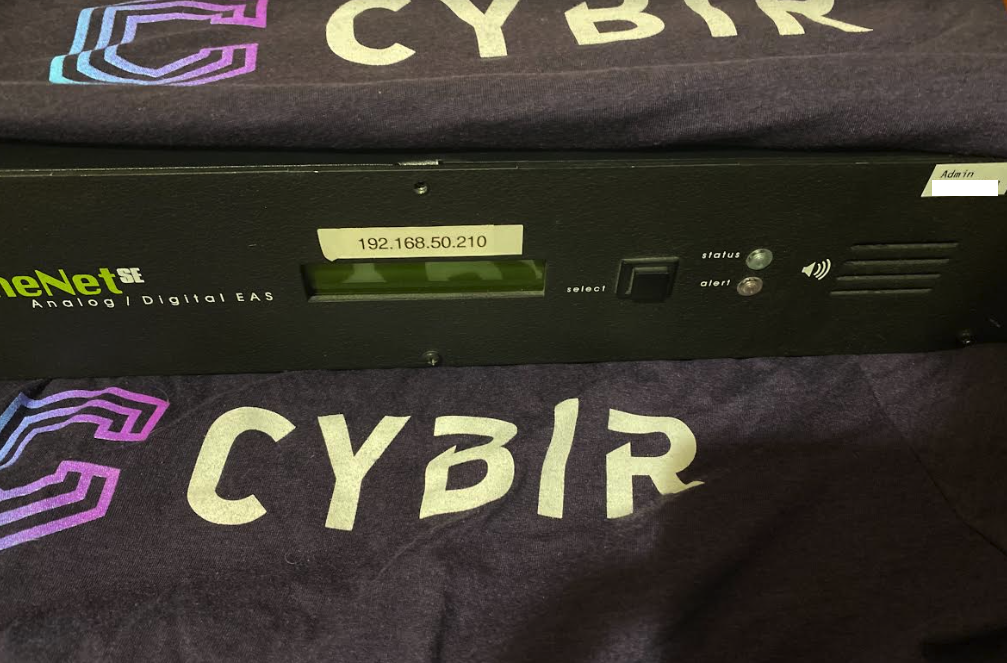
advance of a workshop to be held this weekend at the DEFCON security conference in Las Vegas, where a security researcher is slated to demonstrate multiple weaknesses in the nationwide alert system. A Digital Alert Systems EAS encoder/decoder that Pyle said he acquired off eBay in 2019. It had the username and password for the system printed on the machine. The DHS warning was prompted by security researcher Ken Pyle, a partner at security firm Cybir. Pyle said he started acquiring old EAS equipment off of eBay in 2019, and that he quickly identified a number of serious security vulnerabilities in a device that is broadly used by states and localities to encode and decode EAS alert signals. “I found all kinds of problems back then, and reported it to the DHS, FBI and the manufacturer,” Pyle said in an interview with KrebsOnSecurity. “But nothing ever happened. I decided I wasn’t going to tell anyone about it yet because I wanted to give people time to fix it.” Pyle said he took up the research again in earnest after an angry mob stormed the U.S. Capitol on Jan. 6, 2021. “I was sitting there thinking, ‘Holy shit, someone could start a civil war with this thing,”’ Pyle recalled. “I went back to see if this was still a problem, and it turns out it’s still a very big problem. So I decided that unless someone actually makes this public and talks about it, clearly nothing is going to be done about it.” The EAS encoder/decoder devices Pyle acquired were made by Lyndonville, NY-based Digital Alert Systems (formerly Monroe Electronics, Inc.), which issued a security advisory this month saying it released patches in 2019 to fix the flaws reported by Pyle, but that some customers are still running outdated versions of the device’s firmware. That may be because the patches were included in version 4 of the firmware for the EAS devices, and many older models apparently do not support the new software. “The vulnerabilities identified present a potentially serious risk, and we believe both were addressed in software updates issued beginning Oct 2019,” EAS said in a written statement. “We also provided attribution for the researcher’s responsible disclosure, allowing us to rectify the matters before making any public statements. We are aware that some users have not taken corrective actions and updated their software and should immediately take action to update the latest software version to ensure they are not at risk. Anything lower than version 4.1 should be updated immediately. On July 20, 2022, the researcher referred to other potential issues, and we trust the researcher will provide more detail. We will evaluate and work to issue any necessary mitigations as quickly as possible.” But Pyle said a great many EAS stakeholders are still ignoring basic advice from the manufacturer, such as changing default passwords and placing the devices behind a firewall, not directly exposing them to the Internet, and restricting access only to trusted hosts and networks. Pyle, in a selfie that is heavily redacted because the EAS device behind him had its user credentials printed on the lid. Pyle said the biggest threat to the security of the EAS is that an attacker would only need to compromise a single EAS station to send out alerts locally that can be picked up by other EAS systems and retransmitted across the nation. “The process for alerts is automated in most cases, hence, obtaining access to a device will allow you to pivot around,” he said. “There’s no centralized control of the EAS because these devices are designed such that someone locally can issue an alert, but there’s no central control over whether I am the one person who can send or whatever. If you are a local operator, you can send out nationwide alerts. That’s how easy it is to do this.” One of the Digital Alert Systems devices Pyle sourced from an electronics recycler earlier this year was non-functioning, but whoever discarded it neglected to wipe the hard drive embedded in the machine. Pyle soon discovered the device contained the private cryptographic keys and other credentials needed to send alerts through Comcast, the nation’s third-largest cable company. “I can issue and create my own alert here, which has all the valid checks or whatever for being a real alert station,” Pyle said in an interview earlier this month. “I can create a message that will start propagating through the EAS.” Comcast told KrebsOnSecurity that “a third-party device used to deliver EAS alerts was lost in transit by a trusted shipping provider between two Comcast locations and subsequently obtained by a cybersecurity researcher. “We’ve conducted a thorough investigation of this matter and have determined that no customer data, and no sensitive Comcast data, were compromised,” Comcast spokesperson David McGuire said. The company said it also confirmed that the information included on the device can no longer be used to send false messages to Comcast customers or used to compromise devices within Comcast’s network, including EAS devices. “We are taking steps to further ensure secure transfer of such devices going forward,” McGuire said. “Separately, we have conducted a thorough audit of all EAS devices on our network and confirmed that they are updated with currently available patches and are therefore not vulnerable to recently reported security issues. We’re grateful for the responsible disclosure and to the security research community for continuing to engage and share information with our teams to make our products and technologies ever more secure. Mr. Pyle informed us promptly of his research and worked with us as we took steps to validate his findings and ensure the security of our systems.” The user interface for an EAS device. Unauthorized EAS broadcast alerts have happened enough that there is a chronicle of EAS compromises over at fandom.com. Thankfully, most of these incidents have involved fairly obvious hoaxes. According to the EAS wiki, in February 2013, hackers broke into the EAS networks in Great Falls, Mt. and Marquette, Mich. to broadcast an alert that zombies had risen from their graves in several counties. In Feb. 2017, an EAS station in Indiana also was hacked, with the intruders playing the same “zombies and dead bodies” audio from the 2013 incidents. “On February 20 and February 21, 2020, Wave Broadband’s EASyCAP equipment was hacked due to the equipment’s default password not being changed,” the Wiki states. “Four alerts were broadcasted, two of which consisted of a Radiological Hazard Warning and a Required Monthly Test playing parts of the Hip Hop song Hot by artist Young Thug.” In January 2018, Hawaii sent out an alert to cell phones, televisions and radios, warning everyone in the state that a missile was headed their way. It took 38 minutes for Hawaii to let people know the alert was a misfire, and that a draft alert was inadvertently sent. The news video clip below about the 2018 event in Hawaii does a good job of walking through how the EAS works.
Kaspersky linked an attack campaign deploying the new PortDoor malware, backdooring the defense industry in Eastern Europe, to Chinese APT TA428. The cyberespionage operation has been targeting design bureaus, research institutes, industrial plants, government agencies, and ministries across Belarus, Russia, Ukraine, and Afghanistan.
Payment cards from most major banks and ewallet services in the country are accepted by the gateway, making the incident especially concerning. While it is unclear when the incident occurred, iPay88 said that the leak was detected on May 31.
On July 26, 2022, the Acting New Jersey Attorney General announced that the state is co-leading an $8 million multistate settlement with Wawa, Inc. (Wawa) that resolves a data breach that occurred from April 18, 2019, to December 12, 2019.
Similar to previous routines, this new component is spread via fake crack (also known as warez) websites. The component is usually distributed in one dropper together with a browser stealer and bundled with other unrelated pieces of malware.
Not surprisingly, slick, experienced threat actors are shifting their focus more and more to using so-called “shortcut” or LNK files to deliver their malware more quickly, the HP Wolf Security Threat Insights Report noted.
Bitter APT is spreading Dracarys Android spyware via a trojanized version of Signal, an encrypted messaging app, to harvest sensitive data from users across the globe. The cyberespionage campaigns are conducted against users in New Zealand, the U.K, India, and Pakistan.
A former Twitter employee, Ahmad Abouammo (44), was found guilty of gathering private information of certain Twitter users and passing them to Saudi Arabia. The man faces from 10 up to 20 years in prison when he’s sentenced.
A cyberattack on a major IT provider of the NHS has been confirmed as a ransomware attack. Advanced, which provides digital services like patient check-in and NHS 111, says it may take three to four weeks to fully recover.
For initial infection, the DoNot Team uses spear phishing emails containing malicious attachments. To load the next stage they leverage Microsoft Office macros and RTF files exploiting Equation Editor vulnerability and remote template injection.
Researchers at Resecurity have observed hackers using open redirect vulnerabilities in online service domains and apps, such as Snapchat, to bait unsuspecting users. The use of this tactic allows hackers to deliver phishing content while dodging spam filters. The specially crafted URLs lead users to malicious resources with a phishing kit called LogoKit.
Security analysts have found security issues in the payment system present on Xiaomi smartphones that rely on MediaTek chips providing the trusted execution environment (TEE) that is responsible for signing transactions.
OT and IoT cybersecurity company SCADAfence has discovered potentially serious vulnerabilities in a widely used building management system made by Alerton, a brand of industrial giant Honeywell.
The funding was led by Amiti, with participation from GFC, Amdocs Ventures, and industry leaders such as CyberArk CEO Udi Mokady and Demisto CEO and co-founder Slavik Markovich.
"KrbRelay" is a tool for forced authentication issue in Windows that can be used by a low-privileged domain user to take over a Windows computer, potentially becoming a local or domain admin within minutes.
Zeppelin is a derivative of the Delphi-based Vega malware family and functions as a RaaS. Zeppelin actors have been known to request ransom payments in Bitcoin, with initial amounts ranging from several thousand dollars to over a million dollars.
CISA orders federal government agencies to fix the two security issues in Zimbra by August 25, 2022. The vendor has already released security updates to address both vulnerabilities.
The healthcare industry has dealt with lots of heavy attacks originating from both attempts to exploit vulnerabilities, as well as spear phishing. Quickly patching vulnerabilities must be made a high priority.
The Department of Veterans Affairs Inspector General's office said the agency is "leaving its systems vulnerable to compromise by impostors who may gain access to protected information."
According to the researchers from Securelist, DeathStalker has been updating the features of VileRAT through 2021, with the latest update observed in June 2022.
The CISA on Wednesday released an election security toolkit to help state and local election officials access a variety of free tools and resources to safeguard their voting systems ahead of the upcoming midterm elections.
According to Daniel Nemiroff, senior principal engineer at Intel, fault injection attacks allow attackers to execute malicious instructions and potentially leak data through clock pin, electromagnetic, and voltage glitches.
This new technique causes a desync between the front-end and the browser, allowing an attacker to “craft high-severity exploits without relying on malformed requests that browsers will never send”, James Kettle noted.
The security hole, tracked as CVE-2022-27255 and rated ‘high severity’, has been described as a stack-based buffer overflow that can allow a remote attacker to cause a crash or achieve arbitrary code execution on devices that use the SDK.
The reward offer, first reported by WIRED, is also notable for the fact that it marks the first time the face of a Conti associate, known as "Target," has been unmasked. The four other associates are "Tramp," "Dandis," "Professor," and "Reshaev."
Morphisec Labs researchers have reported that the group has added new modules to its Windows spyware framework aka YTY, Jaca. These latest samples appear to be used in the wild.
Launched in April 2020, the security testing tool simulates OWASP and API exploits to test the detection capabilities of web application firewalls (WAFs), NGWAFs, RASPs, WAAPs, and, now, API security tools.
Research by CyCognito highlights business continuity risks such as digital asset sprawl, subsidiary risk, and the importance of reducing the time it takes to identify a vulnerable Log4j asset and patch it.
The U.S. Federal Trade Commission today initiated a potentially yearslong attempt to impose new data security and privacy regulations onto the American economy. Agency commissioners voted along party lines to initiate the rule-making process.
Three Nigerian nationals accused of participating in multimillion-dollar business email compromise fraud with a fixation on universities arrived in the United States after extradition from the United Kingdom.
Meta recently took down two cyberespionage campaigns across its social media platforms. These campaigns were being operated by Bitter APT and Transparent Tribe threat groups.
GNUnet is a peer-to-peer framework with focus on providing security. All peer-to-peer messages in the network are confidential and authenticated. The framework provides a transport abstraction layer and can currently encapsulate the network traffic in UDP (IPv4 and IPv6), TCP (IPv4 and IPv6), HTTP, or SMTP messages. show more ...
GNUnet supports accounting to provide contributing nodes with better service. The primary service build on top of the framework is anonymous file sharing.
A heap buffer overflow issue exists in Windows 11 and earlier versions. A malicious application may be able to execute arbitrary code with SYSTEM privileges.
A heap buffer overflow issue exists in Windows 11 and earlier versions. A malicious application may be able to execute arbitrary code with SYSTEM privileges.
Readymade Job Portal Script suffers from a remote SQL injection vulnerability. The researcher requested version information from the vendor while reporting the vulnerability but the company has been unresponsive.
Cisco on Wednesday released patches to contain multiple flaws in its software that could be abused to leak sensitive information on susceptible appliances. The issue, assigned the identifier CVE-2022-20866 (CVSS score: 7.4), has been described as a "logic error" when handling RSA keys on devices running Cisco Adaptive Security Appliance (ASA) Software and Cisco Firepower Threat Defense (FTD)
Back when the internet consisted of a handful of computers networked together across a few research institutions, nobody could have imagined that it would one day form the backbone of a new digital way of life. And that probably explains why none of the researchers who thought up its core technologies — things like packet switching and TCP/IP — gave much consideration to the need to secure the
The U.S. Cybersecurity and Infrastructure Security Agency (CISA) on Thursday added two flaws to its Known Exploited Vulnerabilities Catalog, citing evidence of active exploitation. The two high-severity issues relate to weaknesses in Zimbra Collaboration, both of which could be chained to achieve unauthenticated remote code execution on affected email servers - CVE-2022-27925 (CVSS score: 7.2)
The U.S. State Department on Thursday announced a $10 million reward for information related to five individuals associated with the Conti ransomware group. The reward offer, first reported by WIRED, is also notable for the fact that it marks the first time the face of a Conti associate, known as show more ...
"Target," has been unmasked. The four other associates have been referred to as "Tramp," "Dandis," "
Social media company Meta said it will begin testing end-to-end encryption (E2EE) on its Messenger platform this week for select users as the default option, as the company continues to slowly add security layers to its various chat services. "If you're in the test group, some of your most frequent chats may be automatically end-to-end encrypted, which means you won't have to opt in to the
Security flaws have been identified in Xiaomi Redmi Note 9T and Redmi Note 11 models, which could be exploited to disable the mobile payment mechanism and even forge transactions via a rogue Android app installed on the devices. Check Point said it found the flaws in devices powered by MediaTek chipsets during a security analysis of the Chinese handset maker's "Kinibi" Trusted Execution
A security feature bypass vulnerability has been uncovered in three signed third-party Unified Extensible Firmware Interface (UEFI) boot loaders that allow bypass of the UEFI Secure Boot feature. "These vulnerabilities can be exploited by mounting the EFI System Partition and replacing the existing bootloader with the vulnerable one, or modifying a UEFI variable to load the vulnerable loader
Ransomware is to blame for the closure of all 175 7-Eleven stores in Denmark on Monday. The retailer closed all of its stores in Denmark after its cash registers and payment systems were brought down in the attack. Read more in my article on the Tripwire State of Security blog.
Scammers are stealing money from children, with the alluring but bogus promise that China's tough restrictions on online gaming can be subverted. Read more in my article on the Hot for Security blog.