Amazon Web Services (AWS) has attributed a persistent multi-year cyber espionage campaign targeting Western critical infrastructure, particularly the energy sector, to a group strongly linked with Russia’s Main Intelligence Directorate (GRU), known widely as Sandworm (or APT44). In a report released Monday, the show more ...
cloud giant’s threat intelligence teams revealed that the Russian-nexus actor has maintained a "sustained focus" on North American and European critical infrastructure, with operations spanning from 2021 through the present day. Misconfigured Devices are the Attackers' Gateway Crucially, the AWS investigation found that the initial successful compromises were not due to any weakness in the AWS platform itself, but rather the exploitation of customer misconfigured devices. The threat actor is exploiting a fundamental failure in network defense, that of, customers failing to properly secure their network edge devices and virtual appliances. The operation focuses on stealing credentials and establishing long-term persistence, often by compromising third-party network appliance software running on platforms like Amazon Elastic Compute Cloud (EC2). AWS CISO CJ Moses commented in the report, warning, "Going into 2026, organizations must prioritize securing their network edge devices and monitoring for credential replay attacks to defend against this persistent threat." Persistence and Credential Theft, Part of the Sandworm Playbook AWS observed the GRU-linked group employing several key tactics, techniques, and procedures (TTPs) aligned with their historical playbook: Exploiting Misconfigurations: Leveraging customer-side mistakes, particularly in exposed network appliances, to gain initial access. Establishing Persistence: Analyzing network connections to show the actor-controlled IP addresses establishing persistent, long-term connections to the compromised EC2 instances. Credential Harvesting: The ultimate objective is credential theft, enabling the attackers to move laterally across networks and escalate privileges, often targeting the accounts of critical infrastructure operators. AWS’s analysis of infrastructure overlaps with known Sandworm operations—a group infamous for disruptive attacks like the 2015 and 2016 power grid blackouts in Ukraine—provides high confidence in the attribution. Recently, threat intelligence company Cyble had detected advanced backdoors targeting the defense systems and the TTPs closely resembled Russia's Sandworm playbook. Read: Cyble Detects Advanced Backdoor Targeting Defense Systems via Belarus Military Lure Singular Focus on the Energy Supply Chain The targeting profile analyzed by AWS' threat intelligence teams demonstrates a calculated and sustained focus on the global energy sector supply chain, including both direct operators and the technology providers that support them: Energy Sector: Electric utility organizations, energy providers, and managed security service providers (MSSPs) specializing in energy clients. Technology/Cloud Services: Collaboration platforms and source code repositories essential for critical infrastructure development. Telecommunications: Telecom providers across multiple regions. The geographic scope of the targeting is global, encompassing North America, Western and Eastern Europe, and the Middle East, illustrating a strategic objective to gain footholds in the operational technology (OT) and enterprise networks that govern power distribution and energy flow across NATO countries and allies. From Cloud Edge to Credential Theft AWS’ telemetry exposed a methodical, five-step campaign flow that leverages customer misconfiguration on cloud-hosted devices to gain initial access: Compromise Customer Network Edge Device hosted on AWS: The attack begins by exploiting customer-side vulnerabilities or misconfigurations in network edge devices (like firewalls or virtual appliances) running on platforms like Amazon EC2. Leverage Native Packet Capture Capability: Once inside, the actor exploits the device's own native functionality to eavesdrop on network traffic. Harvest Credentials from Intercepted Traffic: The crucial step involves stealing usernames and passwords from the intercepted traffic as they pass through the compromised device. Replay Credentials Against Victim Organizations’ Online Services and Infrastructure: The harvested credentials are then "replayed" (used) to access other services, allowing the attackers to pivot from the compromised appliance into the broader victim network. Establish Persistent Access for Lateral Movement: Finally, the actors establish a covert, long-term presence to facilitate lateral movement and further espionage. Secure the Edge and Stop Credential Replay AWS has stated that while its infrastructure remains secure, the onus is on customers to correct the foundational security flaws that enable this campaign. The report strongly advises organizations to take immediate action on two fronts: Secure Network Edge: Conduct thorough audits and patching of all network appliances and virtual devices exposed to the public internet, ensuring they are configured securely. Monitor for Credential Replay: Implement advanced monitoring for indicators of compromise (IOCs) associated with credential replay and theft attacks, which the threat actors are leveraging to move deeper into target environments.
SoundCloud has confirmed a cyberattack on its platform after days of user complaints about service disruptions and connectivity problems. In what is being reported as a SoundCloud cyberattack, threat actors gained unauthorized access to one of its systems and exfiltrated a limited set of user data. show more ...
“SoundCloud recently detected unauthorized activity in an ancillary service dashboard,” the company said. “Upon making this discovery, we immediately activated our incident response protocols and promptly contained the activity.” Reports of trouble began circulating over several days, with users reporting that they were unable to connect to SoundCloud or experiencing access issues when using VPNs. After the disruptions persisted, the company issued a public statement on its website acknowledging the SoundCloud cyberattack incident. DoS Follows Initial SoundCloud Cyberattack According to the music hosting service provider, the SoundCloud cyberattack was followed by a wave of denial-of-service attacks that further disrupted access to the platform. The company said it experienced multiple DoS incidents after the breach was contained, two of which were severe enough to take the website offline and prevent users from accessing the service altogether. SoundCloud stated that it was ultimately able to repel the attacks, but the interruptions were enough to draw widespread attention from users and the broader technology community. These events highlighted the cascading impact of a cyberattack on SoundCloud, where an initial security compromise was compounded by availability-focused attacks designed to overwhelm the platform. Scope of Exposed Data and User Impact While the SoundCloud cyberattack raised immediate concerns about user privacy, the company stresses that the exposed data was limited. SoundCloud said its investigation found no evidence that sensitive information had been accessed. “We understand that a purported threat actor group accessed certain limited data that we hold,” the company said. “We have completed an investigation into the data that was impacted, and no sensitive data (such as financial or password data) has been accessed.” Instead, the data involved consisted of email addresses and information already visible on public SoundCloud profiles. According to the company, approximately 20 percent of SoundCloud users were affected by the breach. Although SoundCloud described the data as non-sensitive, the scale of the exposure is notable. Email addresses can still be leveraged in phishing campaigns or social engineering attacks, even when other personal details remain secure. SoundCloud added that it is confident the attackers’ access has been fully shut down. “We are confident that any access to SoundCloud data has been curtailed,” the company said. Security Response and Ongoing Connectivity Issues The company did not attribute the SoundCloud cyberattack to a specific hacking group but confirmed that it is working with third-party cybersecurity experts and has fully engaged its incident response protocols. As part of its remediation efforts, the company said it has enhanced monitoring and threat detection, reviewed and reinforced identity and access controls, and conducted a comprehensive audit of related systems. Some of these security upgrades had unintended consequences. SoundCloud acknowledged that changes made to strengthen its defenses contributed to the VPN connectivity issues reported by users in recent days. “We are actively working to resolve these VPN related access issues,” the company said.
PornHub is facing renewed scrutiny after confirming that some Premium users’ activity data was exposed following a security incident at a third-party analytics provider. The PornHub data breach disclosure comes as the platform faces increasing regulatory scrutiny in the United States and reported extortion attempts show more ...
linked to the stolen data. The issue stems from a data breach linked not to PornHub’s own systems, but to Mixpanel, an analytics vendor the platform previously used. On December 12, 2025, PornHub published a security notice confirming that a cyberattack on Mixpanel led to the exposure of historical analytics data, affecting a limited number of Premium users. According to PornHub, the compromised data included search and viewing history tied to Premium accounts, which has since been used in extortion attempts attributed to the ShinyHunters extortion group. “A recent cybersecurity incident involving Mixpanel, a third-party data analytics provider, has impacted some Pornhub Premium users,” the company stated in its notice dated December 12, 2025. PornHub stresses that the incident did not involve a compromise of its own systems and that sensitive account information remained protected. “Specifically, this situation affects only select Premium users. It is important to note that this was not a breach of Pornhub Premium’s systems. Passwords, payment details, and financial information remain secure and were not exposed.” According to PornHub, the affected records are not recent. The company said it stopped working with Mixpanel in 2021, indicating that any stolen data would be at least four years old. Even so, the exposure of viewing and search behavior has raised privacy concerns, particularly given the stigma and personal risk that can accompany such information if misused. Mixpanel Smishing Attack Triggered Supply-Chain Exposure The root of the incident was a PornHub cyberattack by proxy, a supply-chain compromise. Mixpanel disclosed on November 27, 2025, that it had suffered a breach earlier in the month. The company detected the intrusion on November 8, 2025, after a smishing (SMS phishing) campaign allowed threat actors to gain unauthorized access to its systems. Mixpanel CEO Jen Taylor addressed the incident in a public blog post, stressing transparency and remediation. “On November 8th, 2025, Mixpanel detected a smishing campaign and promptly executed our incident response processes,” Taylor wrote. “We took comprehensive steps to contain and eradicate unauthorized access and secure impacted user accounts. We engaged external cybersecurity partners to remediate and respond to the incident.” Mixpanel said the breach affected only a “limited number” of customers and that impacted clients were contacted directly. The company outlined an extensive response that included revoking active sessions, rotating compromised credentials, blocking malicious IP addresses, performing global password resets for employees, and engaging third-party forensic experts. Law enforcement and external cybersecurity advisors were also brought in as part of the response. OpenAI and PornHub Among Impacted Customers PornHub was not alone among Mixpanel’s customers caught up in the incident. OpenAI disclosed on November 26, 2025, one day before Mixpanel’s public announcement, that it, too, had been affected. OpenAI clarified that the incident occurred entirely within Mixpanel’s environment and involved limited analytics data related to some API users. “This was not a breach of OpenAI’s systems,” the company said, adding that no chats, API requests, credentials, payment details, or government IDs were exposed. OpenAI noted that it uses Mixpanel to manage web analytics on its API front end. PornHub denoted a similar assurance in its own disclosure, stating that it had launched an internal investigation with the support of cybersecurity experts and had engaged with relevant authorities. “We are working diligently to determine the nature and scope of the reported incident,” the company said, while urging users to remain vigilant for suspicious emails or unusual activity. Despite those assurances, the cyberattack on PornHub, albeit indirect, has drawn attention due to the sensitive nature of the exposed data and the reported extortion attempts now linked to it. PornHub Data Breach Comes Amid Expanding U.S. Age-Verification Laws The PornHub data breach arrives at a time when the platform is already under pressure from sweeping age-verification laws across the United States. PornHub is currently blocked in 22 states, including Alabama, Arizona, Arkansas, Florida, Georgia, Idaho, Indiana, Kansas, Kentucky, Mississippi, Montana, Nebraska, North Carolina, North Dakota, Oklahoma, South Carolina, South Dakota, Tennessee, Texas, Utah, Virginia, and Wyoming. These restrictions stem from state laws requiring users to submit government-issued identification or other forms of age authentication to access explicit content. Louisiana was the first state to enact such a law, and others followed after the U.S. Supreme Court ruled in June that Texas’s age-verification statute was constitutional. Although PornHub is not blocked in Louisiana, the requirement for ID verification has had a significant impact. Aylo, PornHub’s parent company, said that the traffic in the state dropped by approximately 80 percent after the law took effect. Aylo has repeatedly criticized the implementation of these laws. “These people did not stop looking for porn. They just migrated to darker corners of the internet that don’t ask users to verify age, that don’t follow the law, that don’t take user safety seriously,” the company said in a statement. Aylo added that while it supports age verification in principle, the current approach creates new risks. Requiring large numbers of adult websites to collect highly sensitive personal information, the company argued, puts users in danger if those systems are compromised.
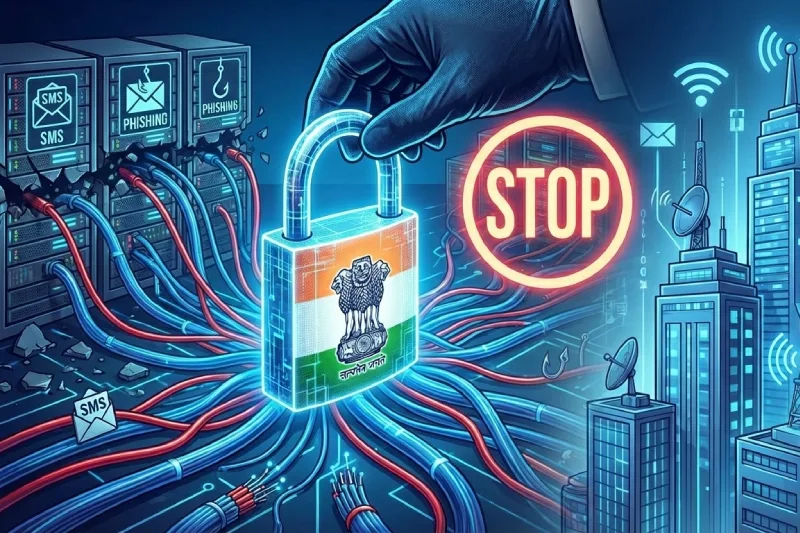
India's Central Bureau of Investigation uncovered and disrupted a large-scale cyber fraud infrastructure, which it calls a "phishing SMS factory," that sent lakhs of smishing messages daily across the country to trick citizens into fake digital arrests, loan scams, and investment frauds. The infrastructure show more ...
that was operated by a registered company, M/s Lord Mahavira Services India Pvt. Ltd., used an online platform to control approximately 21,000 SIM cards that were obtained by violating the Department of Telecommunications rules. The organized cyber gang operating from Northern India provided bulk SMS services to cybercriminals including foreign operators targeting Indian citizens. The CBI arrested three individuals associated to the cyber gang as part of the broader Operation Chakra-V, which is focused on breaking the backbone of cybercrime infrastructure in India. The investigation began when CBI studied the huge volume of fake SMS messages people receive daily that often lead to serious financial fraud. Working closely with the Department of Telecommunications and using information from various sources including the highly debated Sanchar Saathi portal, investigators identified the private company allegedly running the "phishing SMS factory. Active System Seized CBI conducted searches at several locations of North India including Delhi, Noida, and Chandigarh, where it discovered a completely active system used for sending phishing messages. The infrastructure included servers, communication devices, USB hubs, dongles, and thousands of SIM cards operating continuously to dispatch fraud messages. The messages offered fake loans, investment opportunities, and other financial benefits aimed at stealing personal and banking details from innocent people. The scale of operations enabled lakhs of fraud messages to be distributed every day across India. Telecom Channel Partner Involvement Early findings of the investigations suggested an involvement of certain channel partners of telecom companies and their employees who helped illegally arrange SIM cards for the fraudulent operations. This insider facilitation allowed the gang to obtain the massive quantity of SIM cards despite telecommunications regulations designed to prevent such accumulation. The 21,000 SIM cards were controlled through an online platform specifically designed to send bulk messages, the CBI said. Digital Evidence and Cryptocurrency Seized CBI also seized important digital evidence, unaccounted cash, and cryptocurrency during the operation. The seizures provide investigators with critical data to trace financial flows, identify additional conspirators, and understand the full scope of the fraud network's operations. The discovery that foreign cyber criminals were using this service to cheat Indian citizens highlights the transnational nature of the operation, with domestic infrastructure being leveraged by overseas fraudsters to target vulnerable Indians. Operation Chakra-V Targets Infrastructure The dismantling of this phishing SMS factory demonstrates CBI's strategy under Operation Chakra-V to attack the technical backbone of organized cybercrime rather than merely arresting individual fraudsters. By disrupting the infrastructure enabling mass fraud communications, authorities aim to prevent thousands of potential victims from receiving deceptive messages. As part of Operation Chakra-V crackdown, on Sunday, CBI also filed charges against 17 individuals including four likely Chinese nationals and 58 companies for their alleged involvement in a transnational cyber fraud network operating across multiple Indian states. CBI said a single cybercrime syndicate was behind this extensive digital and financial infrastructure that has already defrauded thousands of Indians worth more than ₹1,000 crore. The operators used misleading loan apps, fake investment schemes, Ponzi and MLM models, fake part-time job offers, and fraudulent online gaming platforms for carrying out the cyber fraud. Google advertisements, bulk SMS campaigns, SIM-box based messaging systems, cloud infrastructure, fintech platforms and multiple mule bank account were all part of the modus operandi of this cybercriminal network. Earlier last week, the CBI had filed similar charges against 30 people including two Chinese nationals who ran shell companies and siphoned money from Indian investors through fake cryptocurrency mining platforms, loan apps, and fake online job offers during the COVID-19 lockdown period. Read: CBI Files Chargesheet Against 30 Including Two Chinese Nationals in ₹1,000 Cr Cyber Fraud Network
For years, data privacy in India lived in a grey zone. Mobile numbers demanded at checkout counters. Aadhaar photocopies lying unattended in hotel drawers. Marketing messages that arrived long after you stopped using a service. Most of us accepted this as normal, until the law caught up. That moment has arrived. show more ...
The Digital Personal Data Protection Act (DPDP Act), 2023, backed by the Digital Personal Data Protection Rules, 2025 notified by the Ministry of Electronics and Information Technology (MeitY) on 13 November 2025, marks a decisive shift in how personal data must be treated in India. As the country heads into 2026, businesses are entering the most critical phase: execution. Companies now have an 18-month window to re-engineer systems, processes, and accountability frameworks across IT, legal, HR, marketing, and vendor ecosystems. The change is not cosmetic. It is structural. As Sandeep Shukla, Director, International Institute of Information Technology Hyderabad (IIIT Hyderabad), puts it bluntly: “Well, I can say that Indian Companies so far has been rather negligent of customer's privacy. Anywhere you go, they ask for your mobile number.” The DPDP Act is designed to ensure that such casual indifference to personal data does not survive the next decade. Below are eight fundamental ways the DPDP Act will change how Indian companies handle data in 2026, with real-world implications for businesses, consumers, and the digital economy. 1. Privacy Will Movefromthe Back Office to the Boardroom Until now, data protection in Indian organizations largely sat with compliance teams or IT security. That model will not hold in 2026. The DPDP framework makes senior leadership directly accountable for how personal data is handled, especially in cases of breaches or systemic non-compliance. Privacy risk will increasingly be treated like financial or operational risk. According to Shashank Bajpai, CISO & CTSO at YOTTA, “The DPDP Act (2023) becomes operational through Rules notified in November 2025; the result is a staggered compliance timetable that places 2026 squarely in the execution phase. That makes 2026 the inflection year when planning becomes measurable operational work and when regulators will expect visible progress.” In 2026, privacy decisions will increasingly sit with boards, CXOs, and risk committees. Metrics such as consent opt-out rates, breach response time, and third-party risk exposure will become leadership-level conversations, not IT footnotes. 2. Consent Will Become Clear, Granular, and Reversible One of the most visible changes users will experience is how consent is sought. Under the DPDP Act, consent must be specific, informed, unambiguous, and easy to withdraw. Pre-ticked boxes and vague “by using this service” clauses will no longer be enough. As Gauravdeep Singh, State Head (Digital Transformation), e-Mission Team, MeitY, explains, “Data Principal = YOU.” Whether it’s a food delivery app requesting location access or a fintech platform processing transaction history, individuals gain the right to control how their data is used—and to change their mind later. 3. Data Hoarding Will Turnintoa Liability For many Indian companies, collecting more data than necessary was seen as harmless. Under the DPDP Act, it becomes risky. Organizations must now define why data is collected, how long it is retained, and how it is securely disposed of. If personal data is no longer required for a stated purpose, it cannot simply be stored indefinitely. Shukla highlights how deeply embedded poor practices have been, “Hotels take your aadhaar card or driving license and copy and keep it in the drawers inside files without ever telling the customer about their policy regarding the disposal of such PII data safely and securely.” In 2026, undefined retention is no longer acceptable. 4. Third-Party Vendors Will Come Under the Scanner Data processors like cloud providers, payment gateways, CRM platforms, will no longer operate in the shadows. The DPDP Act clearly distinguishes between Data Fiduciaries (companies that decide how data is used) and Data Processors (those that process data on their behalf). Fiduciaries remain accountable, even if the breach occurs at a vendor. This will force companies to: Audit vendors regularly Rewrite contracts with DPDP clauses Monitor cross-border data flows As Shukla notes, “The shops, E-commerce establishments, businesses, utilities collect so much customer PII, and often use third party data processor for billing, marketing and outreach. We hardly ever get to know how they handle the data.” In 2026, companies will be required to audit vendors, strengthen contracts, and ensure processors follow DPDP-compliant practices, because liability remains with the fiduciary. 5. Breach Response Will Be Timed, Tested, and Visible Data breaches are no longer just technical incidents, they are legal events. The DPDP Rules require organizations to detect, assess, and respond to breaches with defined processes and accountability. Silence or delay will only worsen regulatory consequences. As Bajpai notes, “The practical effect is immediate: companies must move from policy documents to implemented consent systems, security controls, breach workflows, and vendor governance.” Tabletop exercises, breach simulations, and forensic readiness will become standard—not optional. 6. SignificantData Fiduciaries (SDFs) Will Face Heavier Obligations Not all companies are treated equally under the DPDP Act. Significant Data Fiduciaries (SDFs)—those handling large volumes of sensitive personal data, will face stricter obligations, including: Data Protection Impact Assessments Appointment of India-based Data Protection Officers Regular independent audits Global platforms like Meta, Google, Amazon, and large Indian fintechs will feel the pressure first, but the ripple effect will touch the entire ecosystem. 7. A New Privacy Infrastructure Will Emerge The DPDP framework is not just regulation—it is ecosystem building. As Bajpai observes, “This is not just regulation; it is an economic strategy to build domestic capability in cloud, identity, security and RegTech.” Consent Managers, auditors, privacy tech vendors, and compliance platforms will grow rapidly in 2026. For Indian startups, DPDP compliance itself becomes a business opportunity. 8. Trust Will Become a Competitive Advantage Perhaps the biggest change is psychological. In 2026, users will increasingly ask: Why does this app need my data? Can I withdraw consent? What happens if there’s a breach? One Reddit user captured the risk succinctly, “On paper, the DPDP Act looks great… But a law is only as strong as public awareness around it.” Companies that communicate transparently and respect user choice will win trust. Those that don’t will lose customers long before regulators step in. Preparing for 2026: From Awareness to Action As Hareesh Tibrewala, CEO at Anhad, notes, “Organizations now have the opportunity to prepare a roadmap for DPDP implementation.” For many businesses, however, the challenge lies in turning awareness into action, especially when clarity around timelines and responsibilities is still evolving. The concern extends beyond citizens to companies themselves, many of which are still grappling with core concepts such as consent management, data fiduciary obligations, and breach response requirements. With penalties tiered by the nature and severity of violations—ranging from significant fines to amounts running into hundreds of crores, this lack of understanding could prove costly. In 2026, regulators will no longer be looking for intent, they will be looking for evidence of execution. As Bajpai points out, “That makes 2026 the inflection year when planning becomes measurable operational work and when regulators will expect visible progress.” What Companies Should Do Now: A Practical DPDP Act Readiness Checklist As India moves closer to full DPDP enforcement, organizations that act early will find compliance far less disruptive. At a minimum, businesses should focus on the following steps: Map personal data flows: Identify what personal data is collected, where it resides, who has access to it, and which third parties process it. Review consent mechanisms: Ensure consent requests are clear, purpose-specific, and easy to withdraw, across websites, apps, and internal systems. Define retention and deletion policies: Establish how long different categories of personal data are retained and document secure disposal processes. Assess third-party risk: Audit vendors, cloud providers, and processors to confirm DPDP-aligned controls and contractual obligations. Strengthen breach response readiness: Put tested incident response and notification workflows in place, not just policies on paper. Train employees across functions: Build awareness beyond IT and legal teams, privacy failures often begin with everyday operational mistakes. Assign ownership and accountability: Clearly define who is responsible for DPDP compliance, reporting, and ongoing monitoring. These steps are not about ticking boxes; they are about building muscle memory for a privacy-first operating environment. 2026 Is the Year Privacy Becomes Real The DPDP Act does not promise instant perfection. What it demands is accountability. By 2026, privacy will move from policy documents to product design, from legal fine print to leadership dashboards, and from reactive fixes to proactive governance. Organizations that delay will not only face regulatory penalties, but they also risk losing customer trust in an increasingly privacy-aware market. As Sandeep Shukla cautions, “It will probably take years before a proper implementation at all levels of organizations would be seen.” But the direction is clear. Personal data in India can no longer be treated casually. The DPDP Act marks the end of informal data handling, and the beginning of a more disciplined, transparent, and accountable digital economy.
Two recent cybersecurity incidents involving financial services providers have exposed the personal information of millions of individuals, highlighting ongoing risks across the fintech and credit reporting ecosystem. The larger of the two incidents involves Prosper Marketplace cybersecurity incident, confirmed last show more ...
week by the San Francisco-based fintech company. Prosper disclosed that 13.1 million people were affected after unauthorized activity was discovered on its systems on September 1, 2025. A subsequent investigation revealed that attackers accessed data between June and August 2025. Prosper Marketplace Cybersecurity Incident Details In its official notice, Prosper stated, "On September 1, 2025, Prosper discovered unauthorized activity on our systems. We acted quickly to stop the activity and enhance our security measures, and we began working with a leading cybersecurity firm to investigate what happened." While Prosper emphasized that there was no evidence of unauthorized access to customer accounts or funds, attackers were able to obtain a wide range of sensitive personal and financial data. The exposed information includes names, Social Security numbers, national ID numbers, dates of birth, bank account numbers, Prosper account numbers, financial application details, driver’s license numbers, passports, tax information, and payment card numbers. Regulatory filings show the scale of the exposure across states, with more than 1.1 million affected individuals in Texas, 236,000 in South Carolina, and 249,000 in Washington state. Prosper said it has begun notifying affected individuals and is offering two years of credit monitoring and identity restoration services through Experian. The company also confirmed that law enforcement was notified about cybersecurity incidents, and additional security and monitoring controls have been deployed. Founded in 2005, Prosper is best known for its peer-to-peer lending platform, through which more than 2 million customers have borrowed over $28 billion in personal loans. The company also offers home equity loans, lines of credit, and credit card products. 700Credit Security Incident Impacts Over 5.8 Million People In a separate cybersecurity incident, Michigan-based 700Credit data exposure affected 5,836,521 individuals, according to a notice issued on Friday. The incident was discovered on October 25, 2025, when the company’s IT team identified unauthorized access to its systems. 700Credit provides credit reports, compliance solutions, identity verification, and fraud detection services to car dealerships across the U.S. The company said attackers made copies of data stored within its systems. The compromised information includes names, Social Security numbers, dates of birth, and physical addresses. Following the incident, 700Credit confirmed it will file a consolidated breach notice with the FTC on behalf of its affected dealership clients, after receiving approval from the agency. “We timely notified the FBI and the FTC and confirmed with the FTC that 700Credit’s filing on behalf of all dealers is sufficient to meet dealer obligations to notify the FTC. In addition, we will be notifying State AG offices on behalf of dealers. Impacted consumers will also be notified and offered credit monitoring services and assistance they may need. 700Credit has also been working directly with NADA,” the company said in a notice. As a result, dealers are not required to file separate FTC breach notifications related to this incident. However, dealers are still responsible for complying with state-level breach notification requirements, which remain unaffected by the FTC’s decision. Dealers have been advised to consult legal counsel to ensure compliance with applicable state laws. Financial Services Sector Faces Rising Cybersecurity Incidents The Prosper and 700Credit incidents come just weeks after a cyberattack on SitusAMC, a company used by major banks for real estate loan and mortgage services. That incident, discovered on November 12, 2025, involved stolen accounting records and legal agreements. Together, these cybersecurity incidents emphasise a growing trend: financial services providers and fintech companies are increasingly targeted for the volume and sensitivity of data they hold. While no threat actor has publicly claimed responsibility for either the Prosper Marketplace or 700Credit incidents, the scale of exposure raises concerns about identity theft, financial fraud, and long-term consumer risk. Both companies have urged affected individuals to remain vigilant, monitor their credit reports, and report any suspicious activity.
Admit it: you’ve been meaning to jump on the latest NFT reincarnation — Telegram Gifts — but just haven’t gotten around to it. It’s the hottest trend right now. Developers are churning out collectible images in partnership with celebs like Snoop Dogg. All your friends’ profiles are already decked out with show more ...
these modish pictures, and you’re dying to hop on this hype train — but pay as little as possible for it. And then it happens — a stranger messages you privately with a generous offer: a chance to snag a couple of these digital gifts — with no investment required. A bot that looks completely legit is running an airdrop. In the world of NFTs, an airdrop is a promotional stunt where a small number of new crypto assets are given away for free. The buzzword has been adopted on Telegram, thanks to the crypto nature of these gifts and the NFT mechanics running under the hood. Limited time offer: a marketer’s favorite trick… and a scammer’s tool They’re offering you these gift images for free — or so they say. You could later attach them to your profile or sell them for Telegram’s native currency, Toncoin. You don’t even have to tap an external link. Just hit a button in the message, launch a Mini App right inside Telegram itself, and enter your login credentials. And then… your account immediately gets hijacked. You won’t get any gifts, and overall, you’ll be left with anything but a celebratory feeling. This is the first of the screens where, by filling in the fields, you receive a gift lose access to your Telegram account Today, we break down a phishing scheme that exploits Telegram’s built-in Mini Apps, and share tips to help you avoid falling for these attacks. How the new phishing scheme works The principle of classic phishing is straightforward: the user gets a link to a fake website that mimics a legitimate sign-in form. When the victim enters their credentials, this data goes straight to the scammer. However, phishing tactics are constantly evolving, and this new attack method is far more insidious. The bad actors create phishing Mini Apps directly inside Telegram. These appear as standard web pages but are embedded within the messaging app’s interface instead of opening in an external browser. To the user, these apps look completely legitimate. After all, they run within the official Telegram app itself. To make it even more convincing, scammers often add a plausible-sounding limit on gifts per user This leads the victim to think, “If this app runs inside Telegram, there must be some kind of vetting process for these apps. Surely they wouldn’t let an obvious scam through?” In practice, it turns out that’s not the case at all. How is this scheme even a thing? A core security issue with Telegram Mini Apps is that the platform does almost no vetting before an app goes live. This is a world apart from the strict review processes used by Google Play and the App Store — although even there, obvious malware occasionally slips through. On Telegram, it’s far easier for bad actors. Essentially, anyone who wishes to create and launch a Mini App can do so. Telegram does not review the code, functionality, or the developer’s intent. This turns a security flaw within a messaging service boasting nearly a billion global users into a global-scale problem. To make matters worse, moderation of these Mini Apps within Telegram is entirely reactive — meaning action is only taken after users start complaining or law enforcement gets involved. This is a global operation, with phishing lures being distributed simultaneously in both Russian and English. However, the Russian version gives away a tell-tale sign of the scammers’ haste and lack of polish. They forgot to remove a clarification question from the AI that generated the text: “Do you need bolder, more official, or humorous options?” In this case, the bait was “gifts” from UFC fighters: a giveaway of “papakhas” — digital gift images of the traditional Dagestani hat released by Telegram in partnership with Khabib Nurmagomedov. An auction for these items did take place, with Pavel Durov even posting about it on his X and Telegram (Khabib reposted these announcements but later deleted them after the auction ended). However, there were only 29 000 of these “papakhas” released, which wasn’t enough to satisfy all the eager fans. Scammers seized on the opportunity, assuring fans they could get the exclusive items for free. The phishing campaign was a targeted one — focusing on users who’d been active on the athlete’s channel. How the scammers lull their victims The criminals leveraged the name of the popular Portals platform — a legitimate service for games, apps, and entertainment within Telegram. They created a series of Mini Apps that were visually almost indistinguishable from the real ones, and promoted them as free giveaways — airdrops. To add a veneer of authenticity, the scammers even listed the official Telegram channel for Portals in the phishing Mini App’s profile. However, the legitimate Portals Market bot has a different username: @portals That said, the scam campaigns themselves show signs of being rushed and cutting design and copywriting costs — with obvious signs of AI involvement. Some of the messages contain leftover text fragments clearly generated by a neural network, which the scammers either forgot or couldn’t be bothered to edit. How to protect your Telegram account from being hacked The golden security rules are simple: stay vigilant, and learn the key hallmarks of these attacks: Verify the source. If you receive a link promising a giveaway from a celebrity or even Telegram itself but sent from an unfamiliar account or a dubious group, don’t click. Cross-check through the celebrity or company’s official channel to see if they’re actually running a promo like that. Inspect the account verification badge. Ascertain that the blue checkmark is real and not just an emoji status or part of the profile name. You can verify this by simply tapping that checkmark icon in the profile. If it’s a Premium emoji status, Telegram will explicitly tell you so. If a checkmark emoji is simply added to the profile name, tapping it doesn’t do anything. But if the account is genuinely verified, tapping the blue checkmark will bring up an official confirmation message from Telegram. Don’t be in a rush to authenticate in Mini Apps. Legitimate Telegram apps typically don’t require you to sign in again through a form inside the Mini App. If you’re prompted to enter your phone number or a verification code, it’s likely a phishing attempt. Look for signs of AI-generated text or design. Weird grammar, unnatural phrasing, or leftover neural network prompts within a message are a red flag. Scammers frequently use AI-powered generation to churn out text quickly and cheaply. Turn on two-step verification (your Telegram password). Do this right now in Settings -> Privacy and Security -> Two-Step Verification. Even if a scammer manages to get your phone number and SMS code, they won’t be able to access your account without this password. Obviously, never share your password with anyone — it’s meant only for you to sign in to your Telegram account. Use a passkey to secure your account. A recent Telegram update added the ability to securely sign in with a passkey. We’ve covered using passkeys with popular services and the associated caveats in detail. A passkey makes it nearly impossible for a malicious actor to steal your account. You can set one up in Settings -> Privacy and Security -> Passkeys. Store your password and passkey in a password manager. If you’ve secured your account with both a password and a passkey, remember that a weak, reused, or compromised password can still be the proverbial “spare key under the mat” for attackers — even if the “front door” is locked with a passkey. Therefore, we recommend creating a strong, unique password for Telegram and storing it — along with your passkey — in Kaspersky Password Manager. This keeps your credentials and keys available across all your devices. Install Kaspersky for Android on your smartphone. Its new anti-phishing technology protects you from phishing links embedded in notifications from any app. What to do if your Telegram account was already stolen The key is keeping calm and acting swiftly. You have just 24 hours to reclaim your account, or you risk losing it permanently. Follow the step-by-step guide to restoring access in our post What to do if your Telegram account is hacked. Finally, a reminder that has become our classic mantra: if an offer looks too good to be true, it almost certainly is. Always verify information through official channels, and never enter your passwords or passkeys into unofficial apps or forms — even if they look legit. Stay vigilant and stay safe. Want more tips on securing your messenger accounts and chats? Check out our related posts: Messengers 101: safety and privacy advice Messaging other platforms via WhatsApp: the pros and cons WhatsApp and Telegram account hijacking: How to protect yourself against scams What to do if your WhatsApp account gets hacked What to do if your Telegram account is hacked
Direct navigation — the act of visiting a website by manually typing a domain name in a web browser — has never been riskier: A new study finds the vast majority of “parked” domains — mostly expired or dormant domain names, or common misspellings of popular websites — are now show more ...
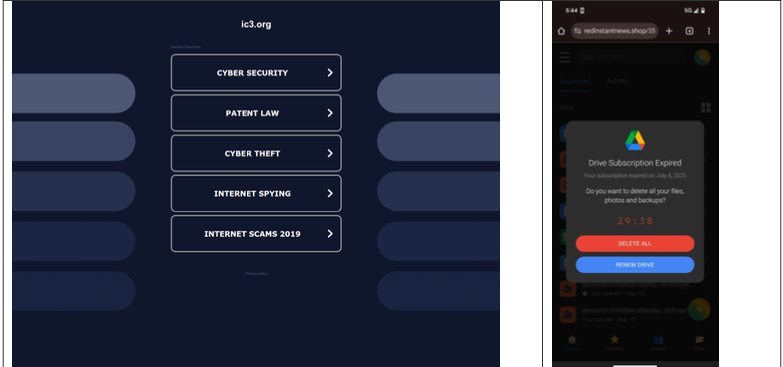
configured to redirect visitors to sites that foist scams and malware. A lookalike domain to the FBI Internet Crime Complaint Center website, returned a non-threatening parking page (left) whereas a mobile user was instantly directed to deceptive content in October 2025 (right). Image: Infoblox. When Internet users try to visit expired domain names or accidentally navigate to a lookalike “typosquatting” domain, they are typically brought to a placeholder page at a domain parking company that tries to monetize the wayward traffic by displaying links to a number of third-party websites that have paid to have their links shown. A decade ago, ending up at one of these parked domains came with a relatively small chance of being redirected to a malicious destination: In 2014, researchers found (PDF) that parked domains redirected users to malicious sites less than five percent of the time — regardless of whether the visitor clicked on any links at the parked page. But in a series of experiments over the past few months, researchers at the security firm Infoblox say they discovered the situation is now reversed, and that malicious content is by far the norm now for parked websites. “In large scale experiments, we found that over 90% of the time, visitors to a parked domain would be directed to illegal content, scams, scareware and anti-virus software subscriptions, or malware, as the ‘click’ was sold from the parking company to advertisers, who often resold that traffic to yet another party,” Infoblox researchers wrote in a paper published today. Infoblox found parked websites are benign if the visitor arrives at the site using a virtual private network (VPN), or else via a non-residential Internet address. For example, Scotiabank.com customers who accidentally mistype the domain as scotaibank[.]com will see a normal parking page if they’re using a VPN, but will be redirected to a site that tries to foist scams, malware or other unwanted content if coming from a residential IP address. Again, this redirect happens just by visiting the misspelled domain with a mobile device or desktop computer that is using a residential IP address. According to Infoblox, the person or entity that owns scotaibank[.]com has a portfolio of nearly 3,000 lookalike domains, including gmai[.]com, which demonstrably has been configured with its own mail server for accepting incoming email messages. Meaning, if you send an email to a Gmail user and accidentally omit the “l” from “gmail.com,” that missive doesn’t just disappear into the ether or produce a bounce reply: It goes straight to these scammers. The report notices this domain also has been leveraged in multiple recent business email compromise campaigns, using a lure indicating a failed payment with trojan malware attached. Infoblox found this particular domain holder (betrayed by a common DNS server — torresdns[.]com) has set up typosquatting domains targeting dozens of top Internet destinations, including Craigslist, YouTube, Google, Wikipedia, Netflix, TripAdvisor, Yahoo, eBay, and Microsoft. A defanged list of these typosquatting domains is available here (the dots in the listed domains have been replaced with commas). David Brunsdon, a threat researcher at Infoblox, said the parked pages send visitors through a chain of redirects, all while profiling the visitor’s system using IP geolocation, device fingerprinting, and cookies to determine where to redirect domain visitors. “It was often a chain of redirects — one or two domains outside the parking company — before threat arrives,” Brunsdon said. “Each time in the handoff the device is profiled again and again, before being passed off to a malicious domain or else a decoy page like Amazon.com or Alibaba.com if they decide it’s not worth targeting.” Brunsdon said domain parking services claim the search results they return on parked pages are designed to be relevant to their parked domains, but that almost none of this displayed content was related to the lookalike domain names they tested. Samples of redirection paths when visiting scotaibank dot com. Each branch includes a series of domains observed, including the color-coded landing page. Image: Infoblox. Infoblox said a different threat actor who owns domaincntrol[.]com — a domain that differs from GoDaddy’s name servers by a single character — has long taken advantage of typos in DNS configurations to drive users to malicious websites. In recent months, however, Infoblox discovered the malicious redirect only happens when the query for the misconfigured domain comes from a visitor who is using Cloudflare’s DNS resolvers (1.1.1.1), and that all other visitors will get a page that refuses to load. The researchers found that even variations on well-known government domains are being targeted by malicious ad networks. “When one of our researchers tried to report a crime to the FBI’s Internet Crime Complaint Center (IC3), they accidentally visited ic3[.]org instead of ic3[.]gov,” the report notes. “Their phone was quickly redirected to a false ‘Drive Subscription Expired’ page. They were lucky to receive a scam; based on what we’ve learnt, they could just as easily receive an information stealer or trojan malware.” The Infoblox report emphasizes that the malicious activity they tracked is not attributed to any known party, noting that the domain parking or advertising platforms named in the study were not implicated in the malvertising they documented. However, the report concludes that while the parking companies claim to only work with top advertisers, the traffic to these domains was frequently sold to affiliate networks, who often resold the traffic to the point where the final advertiser had no business relationship with the parking companies. Infoblox also pointed out that recent policy changes by Google may have inadvertently increased the risk to users from direct search abuse. Brunsdon said Google Adsense previously defaulted to allowing their ads to be placed on parked pages, but that in early 2025 Google implemented a default setting that had their customers opt-out by default on presenting ads on parked domains — requiring the person running the ad to voluntarily go into their settings and turn on parking as a location.
Urban VPN Proxy, which claims to protect users' privacy, collects data from conversations with ChatGPT, Claude, Gemini, Copilot and other AI assistants.
The key elements in a security operations center's strategy map very closely to the swim/bike/run events in a triathlon. SOCs, like triathletes, perform well when their "inputs" are strong.
After several disrupted months as House Homeland Security Committee chairman, Rep. Andrew Garbarino made time to discuss cyber issues such as an upcoming Trump administration strategy document and Chinese state-backed threats.
The president has taken steps to nominate Army Lt. Gen. Joshua Rudd, deputy chief of U.S. Indo-Pacific Command, to lead U.S. Cyber Command and the National Security Agency.
In a press briefing this week, Amazon officials said the years-long campaign “represents a significant evolution in critical infrastructure targeting."
Google has announced that it's discontinuing its dark web report tool in February 2026, less than two years after it was launched as a way for users to monitor if their personal information is found on the dark web. To that end, scans for new dark web breaches will be stopped on January 15, 2026, and the feature will cease to exist effective February 16, 2026. "While the report offered general
The security vulnerability known as React2Shell is being exploited by threat actors to deliver malware families like KSwapDoor and ZnDoor, according to findings from Palo Alto Networks Unit 42 and NTT Security. "KSwapDoor is a professionally engineered remote access tool designed with stealth in mind," Justin Moore, senior manager of threat intel research at Palo Alto Networks Unit 42, said in a
Amazon's threat intelligence team has disclosed details of a "years-long" Russian state-sponsored campaign that targeted Western critical infrastructure between 2021 and 2025. Targets of the campaign included energy sector organizations across Western nations, critical infrastructure providers in North America and Europe, and entities with cloud-hosted network infrastructure. The activity has
AI-assisted coding and AI app generation platforms have created an unprecedented surge in software development. Companies are now facing rapid growth in both the number of applications and the pace of change within those applications. Security and privacy teams are under significant pressure as the surface area they must cover is expanding quickly while their staffing levels remain largely
Threat actors have begun to exploit two newly disclosed security flaws in Fortinet FortiGate devices, less than a week after public disclosure. Cybersecurity company Arctic Wolf said it observed active intrusions involving malicious single sign-on (SSO) logins on FortiGate appliances on December 12, 2025. The attacks exploit two critical authentication bypasses (CVE-2025-59718 and CVE-2025-59719
An ongoing campaign has been observed targeting Amazon Web Services (AWS) customers using compromised Identity and Access Management (IAM) credentials to enable cryptocurrency mining. The activity, first detected by Amazon's GuardDuty managed threat detection service and its automated security monitoring systems on November 2, 2025, employs never-before-seen persistence techniques to hamper
Cybersecurity researchers have discovered a new malicious NuGet package that typosquats and impersonates the popular .NET tracing library and its author to sneak in a cryptocurrency wallet stealer. The malicious package, named "Tracer.Fody.NLog," remained on the repository for nearly six years. It was published by a user named "csnemess" on February 26, 2020. It masquerades as "Tracer.Fody,"
In episode 81 of The AI Fix, Graham discovers that deepfakes are already marking your kids' homework, while Mark glimpses the future when he discovers AI agents that can communicate by reading each other's minds. Also in this episode, a Chinese robot called Miro U proves six arms are better than two; Mark show more ...
discovers a well known prompting technique doesn't work unless you want to make your AI dumber; Network Rail delays 32 trains because of an AI photo of a wonky bridge; and our hosts ponder the explosion of progress on the ARC-AGI-2 reasoning benchmark. All this and much more is discussed in the latest edition of "The AI Fix" podcast by Graham Cluley and Mark Stockley.









_AlexPhotoStock_alamy.png?width=1280&auto=webp&quality=80&disable=upscale)