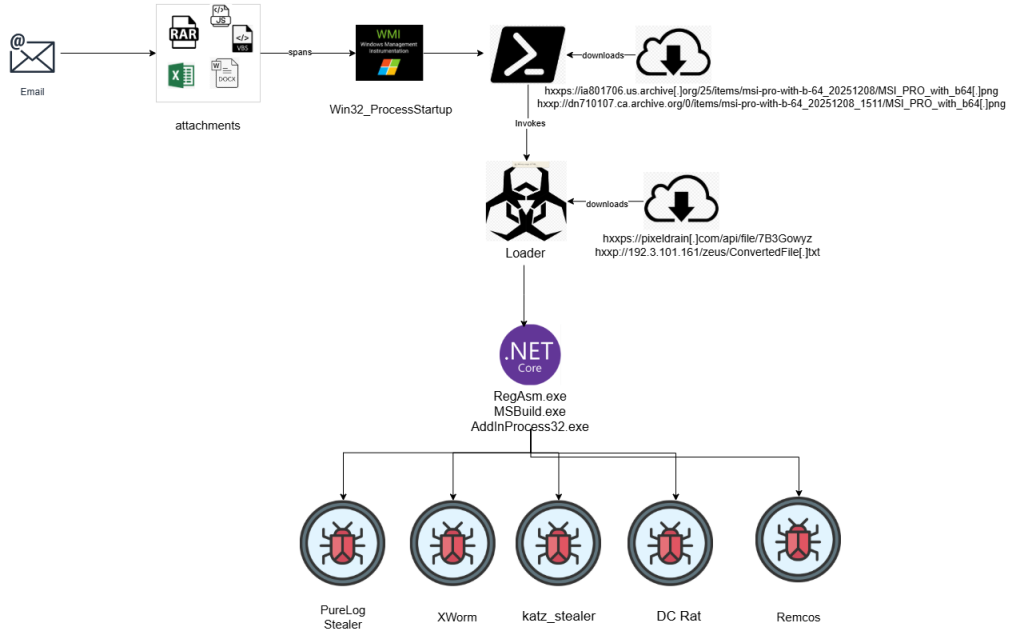
Cyble researchers have identified a sophisticated attack campaign that uses obfuscation, a unique User Account Control (UAC) bypass and other stealthy techniques to deliver a unified commodity loader and infect systems with Remote Access Trojans (RATs) and infostealers. The malware campaign targets the Manufacturing show more ...
and Government sectors in Europe and the Middle East, with a specific focus on Italy, Finland, and Saudi Arabia, but shares common features with other attack campaigns, suggesting a shared malware delivery framework used by multiple “high-capability” threat actors. “The primary objective is the exfiltration of sensitive industrial data and the compromise of high-value administrative credentials,” Cyble Research and Intelligence Labs (CRIL) said in a blog post published today. Sophisticated Attack Campaign Uses Loader Shared by ‘High-capability’ Threat Actors The sophisticated commodity loader at the heart of the campaign is “utilized by multiple high-capability threat actors,” Cyble said. “Our research confirms that identical loader artifacts and execution patterns link this campaign to a broader infrastructure shared across multiple threat actors,” the researchers said. The CRIL researchers describe “a striking uniformity of tradecraft, uncovering a persistent architectural blueprint that serves as a common thread. Despite the deployment of diverse malware payloads, the delivery mechanism remains constant.” Standardized methodology includes the use of steganography to conceal payloads within image files, the use of string reversal and Base64 encoding for obfuscation, and delivering encoded payload URLs directly to the loader. The threat actors also “consistently abuse legitimate .NET framework executables to facilitate advanced process hollowing techniques.” Cyble said researchers from Seqrite, Nextron Systems, and Zscaler, have documented similar findings in other campaigns, including “identical class naming conventions and execution patterns across a variety of malware families and operations.” The researchers shared code samples of the shared loader architecture and noted, “This consistency suggests that the loader might be part of a shared delivery framework used by multiple threat actors.” The loaders have been observed delivering a variety of RATs and infostealers, such as PureLog Stealer, Katz Stealer, DC Rat, Async Rat, and Remcos. “This indicates the loader is likely shared or sold across different threat actor groups,” Cyble said. “The fact that multiple malware families leverage these class naming conventions as well as execution patterns ... is further testament to how potent this threat is to the target nations and sectors,” Cyble added. Campaign Uses Obfuscation, UAC Bypass The campaign documented by Cyble uses “a diverse array of infection vectors,” such as Office documents that weaponize CVE-2017-11882, malicious SVG files, ZIP archives containing LNK shortcuts, and a unique User Account Control (UAC) bypass. One sample used an LNK file and PowerShell to download a VBS loader, along with the UAC bypass method. The UAC bypass technique appears in later stages of the attack, where the malware monitors process creation events and triggers a UAC prompt when a new process is launched, “tricking the system or user into granting elevated privileges under the guise of a routine operation” and “enabling the execution of a PowerShell process with elevated privileges after user approval.” “The discovery of a novel UAC bypass confirms that this is not a static threat, but an evolving operation with a dedicated development cycle,” the researchers added. “Organizations, especially in the targeted regions, should treat ‘benign’ image files and email attachments with heightened scrutiny.” The campaign starts as a phishing campaign masquerading as standard Purchase Order communications. Image files are hosted on legitimate delivery platforms and contain steganographically embedded payloads, “allowing the malicious code to slip past file-based detection systems by masquerading as benign traffic.” The threat actors use a sophisticated “hybrid assembly” technique to “trojanize” open-source libraries. “By appending malicious functions to trusted open-source libraries and recompiling them, the resulting files retain their authentic appearance and functionality, making signature-based detection extremely difficult,” the researchers said. The infection chain is also engineered “to minimize forensic footprint,” including script obfuscation, steganographic extraction, reflective loading to run code directly in memory, and process injection to hide malicious activity within legitimate system processes. The full Cyble blog takes an in-depth technical look at one sample and also includes recommendations, MITRE tactics, techniques and procedures (TTPs), and Indicators of Compromise (IoCs).
The CL0P ransomware group appears to be targeting internet-facing Gladinet CentreStack file servers in its latest extortion campaign. The Curated Intelligence project said in a LinkedIn post that incident responders from its community “have encountered a new CLOP extortion campaign targeting Internet-facing show more ...
CentreStack file servers.” Cyble said in a note to clients today that CL0P appears to be readying its dark web data leak site (DLS) for a new wave of victims following its exploitation of Oracle E-Business Suite vulnerabilities that netted more than 100 victims. “Monitoring of Cl0p's DLS indicates recent archiving and grouping of all previously listed victims associated with Oracle E-Business Suite exploitation under different folders, a move that strongly suggests preparation for a new wave of data leak publications,” Cyble said. “This restructuring activity is assessed to be linked to the ongoing exploitation of Gladinet CentreStack, with Cl0p likely staging victims for coordinated disclosure similar to its prior mass-extortion campaigns. No victim samples or deadlines related to the CentreStack victims have been published yet.” CL0P May Be Targeting Gladinet CentreStack Vulnerabilities It’s not clear if the CL0P campaign is exploiting a known or zero-day vulnerability, but in a comment on the LinkedIn post, Curated Intelligence said that an October Huntress report is “Likely related.” That report focused on CVE-2025-11371, a Files or Directories Accessible to External Parties vulnerability in Gladinet CentreStack and TrioFox that was added to CISA’s Known Exploited Vulnerabilities (KEV) catalog on Nov. 4. In a Dec. 10 report, Huntress noted that threat actors were also targeting CVE-2025-30406, a Gladinet CentreStack Use of Hard-coded Cryptographic Key vulnerability, and CVE-2025-14611, a Gladinet CentreStack and Triofox Hard Coded Cryptographic vulnerability. CVE-2025-30406 was added to the CISA KEV catalog in April, and CVE-2025-14611 was added to the KEV database on Dec. 15. In a Dec. 18 update to that post, Huntress noted the Curated Intelligence findings and said, “At present, we cannot say definitively that this is exploitation by the cl0p ransomware gang, but considering the timing of this reporting, we felt it was prudent to share this recent threat intel.” The latest release on Gladinet's CentreStack website as of December 8 is version 16.12.10420.56791, Huntress noted. “We recommend that potentially impacted Gladinet customers update to this latest version immediately and ensure that the machineKey is rotated,” the blog post said. Curated Intelligence noted that recent port scan data shows more than 200 unique IPs running the “CentreStack - Login” HTTP Title, “making them potential targets of CLOP who is exploiting an unknown CVE (n-day or zero-day) in these systems.” CL0P’s History of File Transfer Attacks Curated Intelligence noted that CL0P has a long history of targeting file sharing and transfer services. “This is yet another similar data extortion campaign by this adversary,” the project said. “CLOP is well-known for targeting file transfer servers such as Oracle EBS, Cleo FTP, MOVEit, CrushFTP, SolarWinds Serv-U, PaperCut, GoAnywhere, among others.” CL0P’s exploitation of Cleo MFT vulnerabilities led to a record number of ransomware attacks earlier this year, and CL0P has also successfully exploited Accellion FTA vulnerabilities. The group’s ability to successfully exploit vulnerabilities at scale has made it a top five ransomware group over its six-year-history (image below from Cyble). [caption id="attachment_107950" align="aligncenter" width="1200"] CL0P is a top five ransomware group over its six-year history (Cyble)[/caption]
The outgoing year of 2025 has significantly transformed our access to the Web and the ways we navigate it. Radical new laws, the rise of AI assistants, and websites scrambling to block AI bots are reshaping the internet right before our eyes. So, what do you need to know about these changes, and what skills and habits show more ...
should you bring with you into 2026? As is our tradition, we’re framing this as eight New Year’s resolutions. What are we pledging for 2026? Get to know your local laws Last year was a bumper crop for legislation that seriously changed the rules of the internet for everyday users. Lawmakers around the world have been busy: Banning social media for teens Introducing strict age verification (think scanning your ID) procedures to visit certain categories of websites Requiring explicit parental consent for minors to access many online services Applying pressure through blocks and lawsuits against platforms that wouldn’t comply with existing child protection laws — with Roblox finding itself in a particularly bright spotlight. Your best bet is to get news from sites that report calmly and without sensationalism, and to review legal experts’ commentary. You need to understand what obligations fall on you, and, if you have underage children, what changes for them. You might face difficult conversations with your kids about new rules for using social media or games. It’s crucial that teenage rebellion doesn’t lead to dangerous mistakes, such as installing malware disguised as a “restriction-bypassing mod” or migrating to small, unmoderated social networks. Safeguarding the younger generation requires reliable protection on their computers and smartphones, alongside parental control tools. But it’s not just about simple compliance with the laws. You will almost certainly encounter negative side effects that lawmakers didn’t anticipate. Master new methods of securing access Some websites choose to geoblock certain countries entirely to avoid the complexities of complying with regional regulations. If you are certain your local laws allow access to the content, you can bypass these geoblocks by using a VPN. You need to select a server in a country where the site is accessible. It’s important to choose a service that doesn’t just offer servers in the right locations, but actually enhances your privacy — as many free VPNs can effectively compromise it. We recommend Kaspersky VPN Secure Connection. Brace for document leaks While age verification can be implemented in different ways, it often involves the website using a third-party verification service. On your first login attempt, you’ll be redirected to a separate site to complete one of several checks: take a photo of your ID or driver’s license, use a bank card, or nod and smile for a video, and so on. The mere idea of presenting a passport to access adult websites is deeply unpopular with many people on principle. But beyond that, there’s a serious risk of data leaks. These incidents are already a reality: data breaches have impacted a contractor used to verify Discord users, as well as service providers for TikTok and Uber. The more websites that require this verification, the higher the risk of a leak becomes. So, what can you do? Prioritize services that do not require document uploads. Instead, look for those utilizing alternative age verification methods, such as a micro-transaction charge to a payment card, confirmation through your bank or another trusted external provider, or behavioral/biometric analysis. Pick the least sensitive and easiest-to-replace document you have, and use only that one for all verifications. “Least sensitive” in this case means containing minimal personal data and not referencing other primary identifiers, such as a national ID number. Use a separate, dedicated email address and phone number in combination with that document. For the sites and services that don’t verify your identity, use completely different contact details. This makes it much harder for your data to be easily pieced together from different leaks. Learn scammers’ new playbook It’s highly likely that under the guise of “age verification”, scammers will begin phishing for personal and payment data, and pushing malware onto visitors. After all, it’s very tempting to simply copy and paste some text on your computer instead of uploading a photo of your passport. Currently, ClickFix attacks are mostly disguised as CAPTCHA checks, but age verification is the logical next step for these schemes. How to lower these risks? Carefully check any websites that require verification. Do not complete the verification if you’ve already done it for that service before, or if you landed on the verification page via a link from a messaging app, search engine, or ad. Never download apps or copy and paste text for verification. All legitimate services operate within the browser window, though sometimes desktop users are asked to switch to a smartphone to complete the check. Analyze and be suspicious of any situation that requires entering a code received via a messaging app or SMS to access a website or confirm an action. This is often a scheme to hijack your messaging account or another critical service. Install reliable security software on all your computers and smartphones to help block access to scam sites. We recommend Kaspersky Premium — it offers a secure VPN, malware protection, alerts if your personal data appears in public leaks, a Kaspersky Password Manager, Kaspersky Safe Kids, and much more. Cultivate healthy AI usage habits Even if you’re not a fan of AI, you’ll find it hard to avoid — it’s literally being shoved into each everyday service: Android, Chrome, MS Office, Windows, iOS, Creative Cloud… the list is endless. As with fast food, television, TikTok, and other easily accessible conveniences, the key is striking a balance between the healthy use of these assistants and developing a dangerous dependency. Identify the areas where your mental sharpness and personal growth matter most to you. A person who doesn’t run regularly loses fitness. Someone who always uses GPS navigation gets worse at reading paper maps. Wherever you value the work of your mind, offloading it to AI is a path to losing your edge. Maintain a balance: regularly do that mental work yourself — even if an AI can do it well — from translating text to looking up info on Wikipedia. You don’t have to do it all the time, but remember to do it often enough. For a more radical approach, you can also disable AI services wherever possible. Know where the cost of a mistake is high. Despite developers’ best efforts, AI can sometimes deliver completely wrong answers with total confidence. These so-called hallucinations are unlikely to be fully eradicated anytime soon. Therefore, for important documents and critical decisions, either avoid using AI entirely or scrutinize its output with extreme care. Check every number, every comma. In other areas, feel free to experiment with AI. But even for seemingly harmless uses, remember that mistakes and hallucinations are a real possibility. How to lower the risk of leaks. The more you use AI, the more of your information goes to the service provider. Whenever possible, prioritize AI features that run entirely on your device. This category includes things like the protection against fraudulent sites in Chrome, text translation in Firefox, the rewriting assistant in iOS, and so on. You can even run a full-fledged chatbot locally on your own computer. AI agents need close supervision. The agentic capabilities of AI — where it doesn’t just suggest but actively does work for you — are especially risky. Thoroughly research the risks in this area before trusting an agent with shopping or booking a vacation. Use modes where the assistant asks for your confirmation before entering personal data, let alone doing any shopping. Audit your subscriptions and plans The economics of the internet are shifting right before our eyes. The AI arms race is driving up the cost of components and computing power, tariffs and geopolitical conflicts are disrupting supply chains, and baking AI features into familiar products sometimes comes with a price hike. Practically any online service can get more expensive overnight, sometimes by double-digit percentages. Some providers are taking a different route, moving away from a fixed monthly fee to a pay-per-use model for things like songs downloaded or images generated. To avoid nasty surprises when you check your bank statement, make it a habit to review the terms of all your paid subscriptions at least three or four times a year. You might find that a service has updated its plans and you need to downgrade to a simpler one. Or a service might have quietly signed you up for an extra feature you’re not even aware of — and you need to disable it. Some services might be better switched to a free tier or canceled altogether. Financial literacy is becoming a must-have skill for managing your digital spending. To get a complete picture of your subscriptions and truly understand how much you’re spending on digital services each month or year, it’s best to track them all in one place. A simple Excel or Google Docs spreadsheet works, but a dedicated app like Subscrab is more convenient. It sends reminders for upcoming payments, shows all your spending month-by-month, and can even help you find better deals on the same or similar services. Prioritize the longevity of your tech While the allure of powerful new processors, cameras, and AI features might tempt you to buy a new smartphone or laptop in 2026, it’s very likely this purchase will last you several years. First, the pace of meaningful new features has slowed, and the urge to upgrade frequently has diminished for many. Second, gadget prices have risen significantly due to more expensive chips, labor and shipping, making major purchases harder to justify. Furthermore, regulations like those in the EU now require easily replaceable batteries in new devices, meaning the part that wears out the fastest in a phone will be simpler and cheaper to swap out yourself. So, what does it take to make sure your smartphone or laptop reliably lasts those years? Physical protection. Use cases, screen protectors, and maybe even a waterproof pouch. Proper storage. Avoid extreme temperatures, don’t leave it baking in direct sun or freezing overnight in a car at –15°C. Battery care. Avoid regularly draining it to single-digit percentages. Regular software updates. This is the trickiest part. Updates are essential for security, protecting your phone or laptop from new types of attacks. However, updates can sometimes cause slowdowns, overheating, or battery drain. The prudent approach is to wait about a week after a major OS update, check feedback from users with your exact model, and only install it if the coast seems clear. Secure your smart home The Smart Home is giving way to a new concept: the Intelligent Home. The idea is that neural networks will help your home make its own decisions about what to do and when, all for your convenience — without needing pre-programmed routines. Thanks to the Matter 1.3 standard, a smart home can now manage not just lights, TVs, and locks, but also kitchen appliances, dryers, and even EV chargers! Even more importantly, we’re seeing a rise in devices where Matter over Thread is the native, primary communication protocol, like the new IKEA KAJPLATS lineup. Matter-powered devices by different vendors can see and communicate with each other. This means you can, say, buy an Apple HomePod as your smart home central hub and connect Philips Hue bulbs, Eve Energy plugs, and IKEA BILRESA switches to it. All of this means that smart and intelligent homes will become more common — and so will the ways to attack them. We have a detailed article on smart home security, but here are a few key tips relevant in light of the transition to Matter. Consolidate your devices into a single Matter fabric. Use the minimum number of controllers, for example, one Apple TV + one smartphone. If a TV or another device accessible to many household members acts as a controller, be sure to use password security and other available restrictions for critical functions. Choose a hub and controller from major manufacturers with a serious commitment to security. Minimize the number of devices connecting your Matter fabric to the internet. These devices, referred to as Border Routers, must be well-protected from external cyberattacks, for example, by restricting their access at the level of your home internet router. Regularly audit your home network for any suspicious, unknown devices. In your Matter fabric, this is done via your controller or hub, and in your home network via your primary router or a feature like Smart Home Monitor in Kaspersky Premium.
Reports of patients being cared for by unqualified home-care aides with fake identities continue to emerge, highlighting a need for more stringent identity authentication.
North Korea shifted its strategy to patiently target "bigger fish" for larger payouts, using sophisticated methods to execute attacks at opportune times.
AI adds real value to cybersecurity today, but it cannot yet serve as a single security guardian. Here's how organizations can safely combine AI-driven analysis with deterministic rules and proven security practices.
Russia’s ambassador to Copenhagen, Vladimir Barbin, confirmed to Russian state media on Friday that he had been called to the Danish foreign ministry, but rejected the accusations as unfounded.
The first-of-its-kind temporary restraining order bars Hisense from using automated content recognition (ACR) technology to collect and use, share or sell Texans’ data.
Kirsten Davies was confirmed for the role, along with about 100 other nominees across federal agencies, in a 53-43 vote following a Republican-led rules change that lets tranches of senior personnel get approved in a bloc by a single vote.
President Donald Trump signed a $901 billion Pentagon policy bill that features a slew of cyber provisions, including a requirement that senior Defense Department officials use phones with “enhanced cybersecurity protections.”
The Justice Department unsealed two indictments charging 54 people for their alleged roles in a campaign to develop and deploy a variant of the Ploutus malware, allowing them to pilfer hundreds of thousands of dollars from ATMs across the U.S.
The Trump administration has pursued a staggering range of policy pivots this past year that threaten to weaken the nation’s ability and willingness to address a broad spectrum of technology challenges, from cybersecurity and privacy to countering disinformation, fraud and corruption. These shifts, along with show more ...
the president’s efforts to restrict free speech and freedom of the press, have come at such a rapid clip that many readers probably aren’t even aware of them all. FREE SPEECH President Trump has repeatedly claimed that a primary reason he lost the 2020 election was that social media and Big Tech companies had conspired to silence conservative voices and stifle free speech. Naturally, the president’s impulse in his second term has been to use the levers of the federal government in an effort to limit the speech of everyday Americans, as well as foreigners wishing to visit the United States. In September, Donald Trump signed a national security directive known as NSPM-7, which directs federal law enforcement officers and intelligence analysts to target “anti-American” activity, including any “tax crimes” involving extremist groups who defrauded the IRS. According to extensive reporting by journalist Ken Klippenstein, the focus of the order is on those expressing “opposition to law and immigration enforcement; extreme views in favor of mass migration and open borders; adherence to radical gender ideology,” as well as “anti-Americanism,” “anti-capitalism,” and “anti-Christianity.” Earlier this month, Attorney General Pam Bondi issued a memo advising the FBI to compile a list of Americans whose activities “may constitute domestic terrorism.” Bondi also ordered the FBI to establish a “cash reward system” to encourage the public to report suspected domestic terrorist activity. The memo states that domestic terrorism could include “opposition to law and immigration enforcement” or support for “radical gender ideology.” The Trump administration also is planning to impose social media restrictions on tourists as the president continues to ramp up travel restrictions for foreign visitors. According to a notice from U.S. Customs and Border Protection (CBP), tourists — including those from Britain, Australia, France, and Japan — will soon be required to provide five years of their social media history. The CBP said it will also collect “several high value data fields,” including applicants’ email addresses from the past 10 years, their telephone numbers used in the past five years, and names and details of family members. Wired reported in October that the US CBP executed more device searches at the border in the first three months of the year than any other previous quarter. The new requirements from CBP add meat to the bones of Executive Order 14161, which in the name of combating “foreign terrorist and public safety threats” granted broad new authority that civil rights groups warn could enable a renewed travel ban and expanded visa denials or deportations based on perceived ideology. Critics alleged the order’s vague language around “public safety threats,” creates latitude for targeting individuals based on political views, national origin, or religion. At least 35 nations are now under some form of U.S. travel restrictions. CRIME AND CORRUPTION In February, Trump ordered executive branch agencies to stop enforcing the U.S. Foreign Corrupt Practices Act, which froze foreign bribery investigations, and even allows for “remedial actions” of past enforcement actions deemed “inappropriate.” The White House also disbanded the Kleptocracy Asset Recovery Initiative and KleptoCapture Task Force — units which proved their value in corruption cases and in seizing the assets of sanctioned Russian oligarchs — and diverted resources away from investigating white-collar crime. Also in February, Attorney General Pam Bondi dissolved the FBI’s Foreign Influence Task Force, an entity created during Trump’s first term designed to counter the influence of foreign governments on American politics. In March 2025, Reuters reported that several U.S. national security agencies had halted work on a coordinated effort to counter Russian sabotage, disinformation and cyberattacks. Former President Joe Biden had ordered his national security team to establish working groups to monitor the issue amid warnings from U.S. intelligence that Russia was escalating a shadow war against Western nations. In a test of prosecutorial independence, Trump’s Justice Department ordered prosecutors to drop the corruption case against New York Mayor Eric Adams. The fallout was immediate: Multiple senior officials resigned in protest, the case was reassigned, and chaos engulfed the Southern District of New York (SDNY) – historically one of the nation’s most aggressive offices for pursuing public corruption, white-collar crime, and cybercrime cases. When it comes to cryptocurrency, the administration has shifted regulators at the U.S. Securities and Exchange Commission (SEC) away from enforcement to cheerleading an industry that has consistently been plagued by scams, fraud and rug-pulls. The SEC in 2025 systematically retreated from enforcement against cryptocurrency operators, dropping major cases against Coinbase, Binance, and others. Perhaps the most troubling example involves Justin Sun, the Chinese-born founder of crypto currency company Tron. In 2023, the SEC charged Sun with fraud and market manipulation. Sun subsequently invested $75 million in the Trump family’s World Liberty Financial (WLF) tokens, became the top holder of the $TRUMP memecoin, and secured a seat at an exclusive dinner with the president. In late February 2025, the SEC dropped its lawsuit. Sun promptly took Tron public through a reverse merger arranged by Dominari Securities, a firm with Trump family ties. Democratic lawmakers have urged the SEC to investigate what they call “concerning ties to President Trump and his family” as potential conflicts of interest and foreign influence. In October, President Trump pardoned Changpeng Zhao, the founder of the world’s largest cryptocurrency exchange Binance. In 2023, Zhao and his company pled guilty to failing to prevent money laundering on the platform. Binance paid a $4 billion fine, and Zhao served a four-month sentence. As CBS News observed last month, shortly after Zhao’s pardon application, he was at the center of a blockbuster deal that put the Trump’s family’s WLF on the map. “Zhao is a citizen of the United Arab Emirates in the Persian Gulf and in May, an Emirati fund put $2 billion in Zhao’s Binance,” 60 Minutes reported. “Of all the currencies in the world, the deal was done in World Liberty crypto.” SEC Chairman Paul Atkins has made the agency’s new posture towards crypto explicit, stating “most crypto tokens are not securities.” At the same time, President Trump has directed the Department of Labor and the SEC to expand 401(k) access to private equity and crypto — assets that regulators have historically restricted for retail investors due to high risk, fees, opacity, and illiquidity. The executive order explicitly prioritizes “curbing ERISA litigation,” and reducing accountability for fiduciaries while shifting risk onto ordinary workers’ retirement savings. At the White House’s behest, the U.S. Treasury in March suspended the Corporate Transparency Act, a law that required companies to reveal their real owners. Finance experts warned the suspension would bring back shell companies and “open the flood gates of dirty money” through the US, such as funds from drug gangs, human traffickers, and fraud groups. Trump’s clemency decisions have created a pattern of freed criminals committing new offenses, including Jonathan Braun, whose sentence for drug trafficking was commuted during Trump’s first term, was found guilty in 2025 of violating supervised release and faces new charges. Eliyahu Weinstein, who received a commutation in January 2021 for running a Ponzi scheme, was sentenced in November 2025 to 37 years for running a new Ponzi scheme. The administration has also granted clemency to a growing list of white-collar criminals: David Gentile, a private equity executive sentenced to seven years for securities and wire fraud (functionally a ponzi-like scheme), and Trevor Milton, the Nikola founder sentenced to four years for defrauding investors over electric vehicle technology. The message: Financial crimes against ordinary investors are no big deal. At least 10 of the January 6 insurrectionists pardoned by President Trump have already been rearrested, charged or sentenced for other crimes, including plotting the murder of FBI agents, child sexual assault, possession of child sexual abuse material and reckless homicide while driving drunk. The administration also imposed sanctions against the International Criminal Court (ICC). On February 6, 2025, Executive Order 14203 authorized asset freezes and visa restrictions against ICC officials investigating U.S. citizens or allies, primarily in response to the ICC’s arrest warrants for Israeli Prime Minister Benjamin Netanyahu over alleged war crimes in Gaza. Earlier this month the president launched the “Gold Card,” a visa scheme established by an executive order in September that offers wealthy individuals and corporations expedited paths to U.S. residency and citizenship in exchange for $1 million for individuals and $2 million for companies, plus ongoing fees. The administration says it is also planning to offer a “platinum” version of the card that offers special tax breaks — for a cool $5 million. FEDERAL CYBERSECURITY President Trump campaigned for a second term insisting that the previous election was riddled with fraud and had been stolen from him. Shortly after Mr. Trump took the oath of office for a second time, he fired the head of the Cybersecurity and Infrastructure Security Agency (CISA) — Chris Krebs (no relation) — for having the audacity to state publicly that the 2020 election was the most secure in U.S. history. Mr. Trump revoked Krebs’s security clearances, ordered a Justice Department investigation into his election security work, and suspended the security clearances of employees at SentinelOne, the cybersecurity firm where Krebs worked as chief intelligence and public policy officer. The executive order was the first direct presidential action against any US cybersecurity company. Krebs subsequently resigned from SentinelOne, telling The Wall Street Journal he was leaving to push back on Trump’s efforts “to go after corporate interests and corporate relationships.” The president also dismissed all 15 members of the Cyber Safety Review Board (CSRB), a nonpartisan government entity established in 2022 with a mandate to investigate the security failures behind major cybersecurity events — likely because those advisors included Chris Krebs. At the time, the CSRB was in the middle of compiling a much-anticipated report on the root causes of Chinese government-backed digital intrusions into at least nine U.S. telecommunications providers. Not to be outdone, the Federal Communication Commission quickly moved to roll back a previous ruling that required U.S. telecom carriers to implement stricter cybersecurity measures. Meanwhile, CISA has lost roughly a third of its workforce this year amid mass layoffs and deferred resignations. When the government shutdown began in October, CISA laid off even more employees and furloughed 65 percent of the remaining staff, leaving only 900 employees working without pay. Additionally, the Department of Homeland Security has reassigned CISA cyber specialists to jobs supporting the president’s deportation agenda. As Bloomberg reported earlier this year, CISA employees were given a week to accept the new roles or resign, and some of the reassignments included relocations to new geographic areas. The White House has signaled that it plans to cut an additional $491 million from CISA’s budget next year, cuts that primarily target CISA programs focused on international affairs and countering misinformation and foreign propaganda. The president’s budget proposal justified the cuts by repeating debunked claims about CISA engaging in censorship. The Trump administration has pursued a similar reorganization at the FBI: The Washington Post reported in October that a quarter of all FBI agents have now been reassigned from national security threats to immigration enforcement. Reuters reported last week that the replacement of seasoned leaders at the FBI and Justice Department with Trump loyalists has led to an unprecedented number of prosecutorial missteps, resulting in a 21 percent dismissal rate of the D.C. U.S. attorney’s office criminal complaints over eight weeks, compared to a mere .5% dismissal rate over the prior 10 years. “These mistakes are causing department attorneys to lose credibility with federal courts, with some judges quashing subpoenas, threatening criminal contempt and issuing opinions that raise questions about their conduct,” Reuters reported. “Grand juries have also in some cases started rejecting indictments, a highly unusual event since prosecutors control what evidence gets presented.” In August, the DHS banned state and local governments from using cyber grants on services provided by the Multi-State Information Sharing and Analysis Center (MS-ISAC), a group that for more than 20 years has shared critical cybersecurity intelligence across state lines and provided software and other resources at free or heavily discounted rates. Specifically, DHS barred states from spending funds on services offered by the Elections Infrastructure ISAC, which was effectively shuttered after DHS pulled its funding in February. Cybersecurity Dive reports that the Trump administration’s massive workforce cuts, along with widespread mission uncertainty and a persistent leadership void, have interrupted federal agencies’ efforts to collaborate with the businesses and local utilities that run and protect healthcare facilities, water treatment plans, energy companies and telecommunications networks. The publication said the changes came after the US government eliminated CIPAC — a framework that allowed private companies to share cyber and threat intel without legal penalties. “Government leaders have canceled meetings with infrastructure operators, forced out their longtime points of contact, stopped attending key industry events and scrapped a coordination program that made companies feel comfortable holding sensitive talks about cyberattacks and other threats with federal agencies,” Cybersecurity Dive’s Eric Geller wrote. Both the National Security Agency (NSA) and U.S. Cyber Command have been without a leader since Trump dismissed Air Force General Timothy Haugh in April, allegedly for disloyalty to the president and at the suggestion of far-right conspiracy theorist Laura Loomer. The nomination of Army Lt. Gen. William Hartman for the same position fell through in October. The White House has ordered the NSA to cut 8 percent of its civilian workforce (between 1,500 and 2,000 employees). As The Associated Press reported in August, the Office of the Director of National Intelligence plans to dramatically reduce its workforce and cut its budget by more than $700 million annually. Director of National Intelligence Tulsi Gabbard said the cuts were warranted because ODNI had become “bloated and inefficient, and the intelligence community is rife with abuse of power, unauthorized leaks of classified intelligence, and politicized weaponization of intelligence.” The firing or forced retirements of so many federal employees has been a boon to foreign intelligence agencies. Chinese intelligence agencies, for example, reportedly moved quickly to take advantage of the mass layoffs, using a network of front companies to recruit laid-off U.S. government employees for “consulting work.” Former workers with the Defense Department’s Defense Digital Service who resigned en-masse earlier this year thanks to DOGE encroaching on their mission have been approached by the United Arab Emirates to work on artificial intelligence for the oil kingdom’s armed forces, albeit reportedly with the blessing of the Trump administration. PRESS FREEDOM President Trump has filed multibillion-dollar lawsuits against a number of major news outlets over news segments or interviews that allegedly portrayed him in a negative light, suing the networks ABC, the BBC, the CBS parent company Paramount, The Wall Street Journal, and The New York Times, among others. The president signed an executive order aimed at slashing public subsidies to PBS and NPR, alleging “bias” in the broadcasters’ reporting. In July, Congress approved a request from Trump to cut $1.1 billion in federal funding for the Corporation for Public Broadcasting, the nonprofit entity that funds PBS and NPR. Brendan Carr, the president’s pick to run the Federal Communications Commission (FCC), initially pledged to “dismantle the censorship cartel and restore free speech rights for everyday Americans.” But on January 22, 2025, the FCC reopened complaints against ABC, CBS and NBC over their coverage of the 2024 election. The previous FCC chair had dismissed the complaints as attacks on the First Amendment and an attempt to weaponize the agency for political purposes. President Trump in February seized control of the White House Correspondents’ Association, the nonprofit entity that decides which media outlets should have access to the White House and the press pool that follows the president. The president invited an additional 32 media outlets, mostly conservative or right-wing organizations. According to the journalism group Poynter.org, there are three religious networks, all of which lean conservative, as well as a mix of outlets that includes a legacy paper, television networks, and a digital outlet powered by artificial intelligence. Trump also barred The Associated Press from the White House over their refusal to refer to the Gulf of Mexico as the Gulf of America. Under Trump appointee Kari Lake, the U.S. Agency for Global Media moved to dismantle Voice of America, Radio Free Europe/Radio Liberty, and other networks that for decades served as credible news sources behind authoritarian lines. Courts blocked shutdown orders, but the damage continues through administrative leave, contract terminations, and funding disputes. President Trump this term has fired most of the people involved in processing Freedom of Information Act (FOIA) requests for government agencies. FOIA is an indispensable tool used by journalists and the public to request government records, and to hold leaders accountable. Petitioning the government, particularly when it ignores your requests, often requires challenging federal agencies in court. But that becomes far more difficult if the most competent law firms start to shy away from cases that may involve crossing the president and his administration. On March 22, the president issued a memorandum that directs heads of the Justice and Homeland Security Departments to “seek sanctions against attorneys and law firms who engage in frivolous, unreasonable and vexatious litigation against the United States,” or in matters that come before federal agencies. The Trump administration announced increased vetting of applicants for H-1B visas for highly skilled workers, with an internal State Department memo saying that anyone involved in “censorship” of free speech should be considered for rejection. Executive Order 14161, issued in 2025 on “foreign terrorist and public safety threats,” granted broad new authority that civil rights groups warn could enable a renewed travel ban and expanded visa denials or deportations based on perceived ideology. Critics charged that the order’s vague language around “public safety threats” creates latitude for targeting individuals based on political views, national origin, or religion. CONSUMER PROTECTION, PRIVACY At the beginning of this year, President Trump ordered staffers at the Consumer Financial Protection Bureau (CFPB) to stop most work. Created by Congress in 2011 to be a clearinghouse of consumer complaints, the CFPB has sued some of the nation’s largest financial institutions for violating consumer protection laws. The CFPB says its actions have put nearly $18 billion back in Americans’ pockets in the form of monetary compensation or canceled debts, and imposed $4 billion in civil money penalties against violators. The Trump administration said it planned to fire up to 90 percent of all CFPB staff, but a recent federal appeals court ruling in Washington tossed out an earlier decision that would have allowed the firings to proceed. Reuters reported this week that an employee union and others have battled against it in court for ten months, during which the agency has been almost completely idled. The CFPB’s acting director is Russell Vought, a key architect of the GOP policy framework Project 2025. Under Vought’s direction, the CFPB in May quietly withdrew a data broker protection rule intended to limit the ability of U.S. data brokers to sell personal information on Americans. Despite the Federal Reserve’s own post-mortem explicitly blaming Trump-era deregulation for the 2023 Silicon Valley Bank collapse, which triggered a fast-moving crisis requiring emergency weekend bailouts of banks, Trump’s banking regulators in 2025 doubled down. They loosened capital requirements, narrowed definitions of “unsafe” banking practices, and stripped specific risk categories from supervisory frameworks. The setup for another banking crisis requiring taxpayer intervention is now in place. The Privacy Act of 1974, one of the few meaningful federal privacy laws, was built on the principles of consent and separation in response to the abuses of power that came to light during the Watergate era. The law states that when an individual provides personal information to a federal agency to receive a particular service, that data must be used solely for its original purpose. Nevertheless, it emerged in June that the Trump administration has built a central database of all US citizens. According to NPR, the White House plans to use the new platform during upcoming elections to verify the identity and citizenship status of US voters. The database was built by the Department of Homeland Security and the Department of Governmental Efficiency and is being rolled out in phases to US states. DOGE Probably the biggest ungotten scoop of 2025 is the inside story of what happened to all of the personal, financial and other sensitive data that was accessed by workers at the so-called Department of Government Efficiency (DOGE). President Trump tapped Elon Musk to lead the newly created department, which was mostly populated by current and former employees of Musk’s various technology companies (including a former denizen of the cybercrime community known as the “Com”). It soon emerged that the DOGE team was using artificial intelligence to surveil at least one federal agency’s communications for hostility to Mr. Trump and his agenda. DOGE employees were able to access and synthesize data taken from a large number of previously separate and highly guarded federal databases, including those at the Social Security Administration, the Department of Homeland Security, the Office of Personnel Management, and the U.S. Department of the Treasury. DOGE staffers did so largely by circumventing or dismantling security measures designed to detect and prevent misuse of federal databases, including standard incident response protocols, auditing, and change-tracking mechanisms. For example, an IT expert with the National Labor Relations Board (NLRB) alleges that DOGE employees likely downloaded gigabytes of data from agency case files in early March, using short-lived accounts that were configured to leave few traces of network activity. The NLRB whistleblower said the large data outflows coincided with multiple blocked login attempts from addresses in Russia, which attempted to use valid credentials for a newly-created DOGE user account. The stated goal of DOGE was to reduce bureaucracy and to massively cut costs — mainly by eliminating funding for a raft of federal initiatives that had already been approved by Congress. The DOGE website claimed those efforts reduced “wasteful” and “fraudulent” federal spending by more than $200 billion. However, multiple independent reviews by news organizations determined the true “savings” DOGE achieved was off by a couple of orders of magnitude, and was likely closer to $2 billion. At the same time DOGE was slashing federal programs, President Trump fired at least 17 inspectors general at federal agencies — the very people tasked with actually identifying and stopping waste, fraud and abuse at the federal level. Those included several agencies (such as the NLRB) that had open investigations into one or more of Mr. Musk’s companies for allegedly failing to comply with protocols aimed at protecting state secrets. In September, a federal judge found the president unlawfully fired the agency watchdogs, but none of them have been reinstated. Where is DOGE now? Reuters reported last month that as far as the White House is concerned, DOGE no longer exists, even though it technically has more than half a year left to its charter. Meanwhile, who exactly retains access to federal agency data that was fed by DOGE into AI tools is anyone’s guess. KrebsOnSecurity would like to thank the anonymous researcher NatInfoSec for assisting with the research on this story.
Authorities in Nigeria have announced the arrest of three "high-profile internet fraud suspects" who are alleged to have been involved in phishing attacks targeting major corporations, including the main developer behind the RaccoonO365 phishing-as-a-service (PhaaS) scheme. The Nigeria Police Force National Cybercrime Centre (NPF–NCCC) said investigations conducted in collaboration with
Certain motherboard models from vendors like ASRock, ASUSTeK Computer, GIGABYTE, and MSI are affected by a security vulnerability that leaves them susceptible to early-boot direct memory access (DMA) attacks across architectures that implement a Unified Extensible Firmware Interface (UEFI) and input–output memory management unit (IOMMU). UEFI and IOMMU are designed to enforce a security
WatchGuard has released fixes to address a critical security flaw in Fireware OS that it said has been exploited in real-world attacks. Tracked as CVE-2025-14733 (CVSS score: 9.3), the vulnerability has been described as a case of out-of-bounds write affecting the iked process that could allow a remote unauthenticated attacker to execute arbitrary code. "This vulnerability affects both the
A suspected Russia-aligned group has been attributed to a phishing campaign that employs device code authentication workflows to steal victims' Microsoft 365 credentials and conduct account takeover attacks. The activity, ongoing since September 2025, is being tracked by Proofpoint under the moniker UNK_AcademicFlare. The attacks involve using compromised email addresses belonging to government
Cybersecurity researchers have disclosed details of a new campaign that has used cracked software distribution sites as a distribution vector for a new version of a modular and stealthy loader known as CountLoader. The campaign "uses CountLoader as the initial tool in a multistage attack for access, evasion, and delivery of additional malware families," Cyderes Howler Cell Threat Intelligence