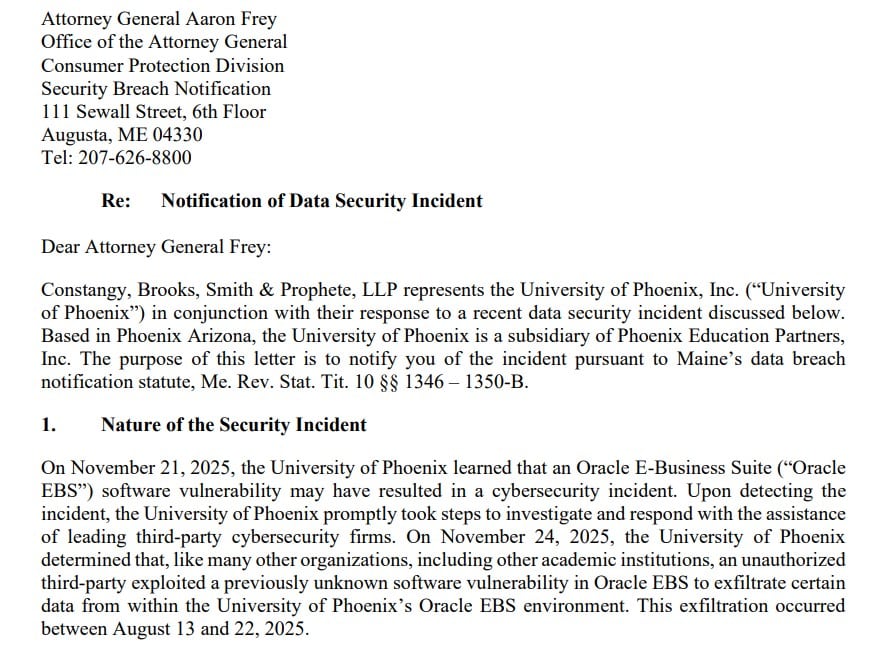
Victims of the CL0P ransomware group’s August campaign targeting Oracle E-Business Suite vulnerabilities are still coping with the aftermath of the cyberattacks, as Korean Air and the University of Phoenix have become the latest to reveal details of the breach. The University of Phoenix reported earlier this month show more ...
in an SEC filing that it was among the Oracle EBS victims, after the company was named as a victim by CL0P on the threat group’s dark web data leak site. In a new filing with the Maine Attorney General’s office, the University of Phoenix revealed the extent of the breach – nearly 3.5 million people may have had their personal data compromised, including names, dates of birth, Social Security numbers, and bank account and routing numbers. The sample notification letter provided by the university offered victims complimentary identity protection services. including a year of credit monitoring, dark web monitoring, a $1 million identity fraud loss reimbursement policy, and identity theft recovery services. Oracle EBS victims continue to grapple with the aftermath of the attacks even as CL0P has reportedly moved on to a new extortion campaign targeting internet-facing Gladinet CentreStack file servers. Korean Air Among Oracle EBS Victims Korean Air also reported a cyberattack that appears linked to the Oracle EBS campaign. According to news reports, KC&D Service – the former in-flight catering subsidiary of the airline that’s now owned by a private equity firm – informed Korean Air of a leak that involved personal data belonging to the airline’s employees. The compromised data involved 30,000 records and included names and bank account numbers. The breach was revealed in an “internal notice,” according to the reports. The airline said no customer data appears to have been compromised by the breach. According to Korea JoongAng Daily, Woo Kee-hong, vice chairman of Korean Air, said in a message to employees, “Korean Air takes this incident very seriously, especially since it involves employee data, even if it originated from a third-party vendor that was sold off. We are currently focusing all our efforts on identifying the full scope of the breach and who was affected.” While the reports didn’t specifically mention the Oracle EBS campaign, “Korean Air Catering” was one of more than 100 victims listed by CL0P on its data leak site. Other confirmed victims in the Oracle campaign have included The Washington Post, Harvard University, Dartmouth College, the University of Pennsylvania, American Airlines’ Envoy Air, Logitech, Cox, Mazda, Canon, and Hitachi’s GlobalLogic. CL0P’s File Services Exploits CL0P’s ability to exploit file sharing and transfer services at scale has made it a top five ransomware group over its six-year history, with more than 1,000 known victims to date, according to Cyble threat intelligence data. Other CL0P campaigns have targeted Cleo MFT, MOVEit, CrushFTP, SolarWinds Serv-U, PaperCut, and GoAnywhere, among others. CL0P’s exploitation of Cleo MFT vulnerabilities led to a record number of ransomware attacks earlier this year, and CL0P has also successfully exploited Accellion FTA vulnerabilities. Some reports have linked the Oracle EBS campaign to the FIN11 threat group, with CL0P acting as the public face of the campaign.
France’s data protection authority, the CNIL, has imposed a €1.7 million GDPR fine on software company NEXPUBLICA FRANCE for failing to implement adequate cybersecurity measures. The penalty was announced on 22 December 2025 following an investigation into a data breach linked to the company’s PCRM software, show more ...
widely used in the social services sector. The regulator said the GDPR fine reflects serious shortcomings in how the company protected sensitive personal data, despite being aware of long-standing security weaknesses before the breach occurred. Data Breach Exposed Third-Party Documents The case dates back to November 2022, when users of a Nexpublica online portal reported that they could access documents belonging to other individuals. These documents included personal files that should have been strictly restricted, raising immediate concerns about data security and access controls. Customers of NEXPUBLICA notified the CNIL after discovering that users could view third-party information through the portal. Given the nature of the data involved, the incident posed a high risk to individuals’ privacy and rights, prompting a formal investigation by the regulator. PCRM Software Used in Sensitive Social Services NEXPUBLICA FRANCE, formerly known as INETUM SOFTWARE FRANCE, specializes in designing IT systems and software. One of its core products, PCRM, is a user relationship management tool used in social action services. It is notably deployed by Departmental Houses for the Disabled (MDPH) in several French departments. Because PCRM processes highly sensitive personal data, including information that can reveal a person’s disability, the CNIL stressed that a high level of security was required. The GDPR fine reflects the sensitivity of the data exposed and the potential harm caused to affected individuals. CNIL Finds Serious Security Failures Following its investigation, the CNIL concluded that the technical and organisational measures implemented to secure PCRM were insufficient. The regulator identified a general weakness in Nexpublica’s information system, along with structural vulnerabilities that had been allowed to persist over time. According to the CNIL, many of these vulnerabilities stemmed from a lack of knowledge of basic cybersecurity principles and current best practices. Several security flaws had already been identified in internal and external audit reports prior to the breach. Despite this, the company failed to correct the issues until after the data breaches were reported. This delay played a key role in the decision to impose the GDPR fine. Violation of Article 32 of the GDPR The CNIL ruled that Nexpublica violated Article 32 of the GDPR, which requires organisations to implement security measures appropriate to the level of risk. This includes considering the state of the art, implementation costs, and the risks posed to individuals’ rights and freedoms. The restricted committee, the CNIL body responsible for sanctions, found that Nexpublica did not meet these requirements. The situation was considered more serious because the company operates as an IT systems and software specialist and should have been fully aware of its security obligations. Why the GDPR Fine Was €1.7 Million In setting the amount of the GDPR fine, the CNIL considered several factors. These included Nexpublica’s financial capacity, the number of people potentially affected, and the sensitive nature of the data processed through PCRM. The regulator also took into account that the security issues were known internally before the breach and were only addressed afterward. While Nexpublica has since implemented corrective measures, the CNIL said this did not outweigh the severity of the earlier failings. As the necessary fixes have now been applied, the CNIL did not issue a separate compliance order. However, the GDPR fine serves as a clear warning to software providers handling sensitive public-sector data: known security weaknesses must be addressed before, not after, a breach occurs.
Two cybersecurity experts charged with deploying ALPHV BlackCat ransomware against five companies have pleaded guilty to federal charges in the case, the U.S. Department of Justice announced today. Ryan Goldberg, 40, of Georgia, and Kevin Martin, 36, of Texas, were indicted in the BlackCat ransomware case in October. show more ...
Together with an unnamed co-conspirator, they “successfully deployed the ransomware known as ALPHV BlackCat between April 2023 and December 2023 against multiple victims located throughout the United States,” the Justice Department said today. The two face sentencing in March for conspiring to obstruct commerce through extortion. Misusing ‘Trusted Access and Technical Skill’ Martin and the co-conspirator worked as ransomware negotiators for DigitalMint, a Chicago-based company that specializes in mitigating cyberattacks, while Goldberg was an incident response manager at Sygnia Cybersecurity Services. DigitalMint and Sygnia have publicly stated they were not targets of the investigation and have cooperated fully with law enforcement. “These defendants used their sophisticated cybersecurity training and experience to commit ransomware attacks — the very type of crime that they should have been working to stop,” stated Assistant Attorney General A. Tysen Duva of the Justice Department’s Criminal Division. “Goldberg and Martin used trusted access and technical skill to extort American victims and profit from digital coercion,” added U.S. Attorney Jason A. Reding Quiñones for the Southern District of Florida. “Their guilty pleas make clear that cybercriminals operating from within the United States will be found, prosecuted, and held to account.” BlackCat Ransomware Case Netted More Than $1 million According to the Justice Department, the three men agreed to pay the ALPHV BlackCat administrators a 20% share of any ransom payments they received in exchange for the ransomware and access to ALPHV BlackCat’s extortion platform. “After successfully extorting one victim for approximately $1.2 million in Bitcoin, the men split their 80% share of this ransom three ways and laundered the funds through various means,” the Justice Department said. The five unnamed victim companies targeted by the co-conspirators included: A medical device company based in Tampa, Florida A pharmaceutical company based in Maryland A doctor’s office based in California An engineering company based in California A drone manufacturer based in Virginia The Tampa medical device company paid a $1.27 million ransom; it is not clear if other ransom payments were made. The Justice Department placed the guilty pleas in the context of priori law enforcement actions aimed at disrupting ALPHV BlackCat, including the development of a decryption tool that that the U.S. says saved global victims nearly $100 million in ransom payments. The Justice Department said Goldberg and Martin each pleaded guilty to one count of “conspiracy to obstruct, delay or affect commerce or the movement of any article or commodity in commerce by extortion in violation of 18 U.S.C. § 1951(a).” The defendants are scheduled to be sentenced on March 12, 2026, and face a maximum penalty of 20 years in prison. The cybersecurity industry has faced a number of insider incidents in recent months, including a “suspicious insider” at CrowdStrike and a former cybersecurity company official who pled guilty to stealing trade secrets to sell them to a Russian buyer. In the Goldberg and Martin case, corporate assets do not appear to have been misused.
The year ahead will see an intensified AI-driven cybersecurity arms race, with attackers leveraging autonomous malware and advanced AI technologies to outpace defenders, while security teams adopt increasingly sophisticated AI tools to combat evolving threats amidst growing vendor consolidation and platformization in the industry.
An analysis of cyber-insurance claims data shows which cyber defenses actually work for policyholders. Here are six technologies that will pay off for companies in 2026.
The Treasury Department on Tuesday took three people closely affiliated with the holding company behind Predator spyware off of a sanctions list, reversing their designation in 2024 by the Biden administration.
Artificial intelligence (AI) is making its way into security operations quickly, but many practitioners are still struggling to turn early experimentation into consistent operational value. This is because SOCs are adopting AI without an intentional approach to operational integration. Some teams treat it as a shortcut for broken processes. Others attempt to apply machine learning to problems
The Chinese hacking group known as Mustang Panda has leveraged a previously undocumented kernel-mode rootkit driver to deliver a new variant of backdoor dubbed TONESHELL in a cyber attack detected in mid-2025 targeting an unspecified entity in Asia. The findings come from Kaspersky, which observed the new backdoor variant in cyber espionage campaigns mounted by the hacking group targeting
The threat actor known as Silver Fox has turned its focus to India, using income tax-themed lures in phishing campaigns to distribute a modular remote access trojan called ValleyRAT (aka Winos 4.0). "This sophisticated attack leverages a complex kill chain involving DLL hijacking and the modular Valley RAT to ensure persistence," CloudSEK researchers Prajwal Awasthi and Koushik Pal said in an
The Cyber Security Agency of Singapore (CSA) has issued a bulletin warning of a maximum-severity security flaw in SmarterTools SmarterMail email software that could be exploited to achieve remote code execution. The vulnerability, tracked as CVE-2025-52691, carries a CVSS score of 10.0. It relates to a case of arbitrary file upload that could enable code execution without requiring any