A former cybersecurity company official charged with stealing trade secrets to sell them to a Russian buyer pleaded guilty to two counts of theft of trade secrets in U.S. District Court today, the U.S. Department of Justice announced. Peter Williams, 39, an Australian national, pleaded guilty to the charges “in show more ...
connection with selling his employer’s trade secrets to a Russian cyber-tools broker,” the Justice Department said in a press release. The Justice Department said Williams stole “national-security focused software that included at least eight sensitive and protected cyber-exploit components” over a three-year period from the U.S. defense contractor where he worked. The Justice Department didn’t name the company where Williams worked, but reports have said Williams is a former director and general manager at L3Harris Trenchant, which does vulnerability and security work for government clients. “Those components were meant to be sold exclusively to the U.S. government and select allies,” the Justice Department said. “Williams sold the trade secrets to a Russian cyber-tools broker that publicly advertises itself as a reseller of cyber exploits to various customers, including the Russian government.” Each of the charges carries a statutory maximum of 10 years in prison and a fine of up to $250,000, the Justice Department says, and Williams also must pay $1.3 million in restitution. U.S. Places Value of Stolen Trade Secrets at $35 Million The U.S. places the value of the stolen trade secrets at $35 million, according to statements from officials. “Williams placed greed over freedom and democracy by stealing and reselling $35 million of cyber trade secrets from a U.S. cleared defense contractor to a Russian Government supplier,” Assistant Director Roman Rozhavsky of the FBI’s Counterintelligence Division said in a statement. “By doing so, he gave Russian cyber actors an advantage in their massive campaign to victimize U.S. citizens and businesses. This plea sends a clear message that the FBI and our partners will defend the homeland and bring to justice anyone who helps our adversaries jeopardize U.S. national security. According to the facts admitted in connection with the guilty plea, the Justice Department said that from approximately 2022 through 2025, “Williams improperly used his access to the defense contractor’s secure network to steal the cyber exploit components that constituted the trade secrets.” The government says he resold those components “in exchange for the promise of millions of dollars in cryptocurrency. To effectuate these sales, Williams entered into multiple written contracts with the Russian broker, which involved payment for the initial sale of the components, and additional periodic payments for follow-on support. Williams transferred the eight components and trade secrets to the Russian broker through encrypted means.” Williams reportedly worked for the Australian Signals Directorate before L3Harris Trenchant. Trenchant’s Secretive Security Business Trenchant was created following the acquisitions of Azimuth Security and Linchpin Labs by defense contractor L3Harris Technologies. According to a company web page, Trenchant’s solutions include vulnerability and exploit research, APIs for intelligence operations, “device and access capabilities,” and computer network operations (CNO) products. TechCrunch put that in plainer terms, saying Trenchant “develops spyware, exploits, and zero-days — security vulnerabilities in software that are unknown to its maker. Trenchant sells its surveillance tech to government customers in Australia, Canada, New Zealand, the United States, and the United Kingdom, the so-called Five Eyes intelligence alliance.”
Security researchers have disclosed a campaign of typosquatted npm packages that automatically execute on install and ultimately deliver a cross-platform credential stealer. According to researchers, the malicious packages were first published on July 4, 2025, remained live for over four months, and together show more ...
collected more than 9,900 downloads before Socket petitioned the npm registry for removal. The actor behind the campaign, a registrant using the name andrew_r1 with the email parvlhonor@gmx[.]com, created ten packages whose names mimic legitimate libraries. Socket’s AI Scanner labeled the most prominent malicious package, dizcordjs, as “Known malware.” The full list of Typosquatted packages observed is: typescriptjs (mimics TypeScript) deezcord.js, dizcordjs, dezcord.js (mimic discord.js) etherdjs, ethesjs, ethetsjs (mimic ethers.js) nodemonjs (mimics nodemon) react-router-dom.js (mimics react-router-dom) zustand.js (mimics zustand) Typosquatted NPM Packages: Obfuscation and Automatic Execution Techniques Automatic, immediate execution is central to the operation. Each package abuses npm’s postinstall lifecycle hook so that simply running npm install triggers the malicious payload. Socket extracted an example package.json used by the attacker that runs node install.js in postinstall. The install.js implements platform detection and spawns a separate terminal window on Windows (cmd), Linux (gnome-terminal/x-terminal-emulator), or macOS (Terminal.app via AppleScript). By launching the payload in a new window and clearing it quickly, the malware runs outside the main npm output and reduces the chance the developer notices. The malicious app.js is heavily obfuscated with four distinct layers designed to defeat static analysis and automated scanners: an eval-based self-decoding wrapper, XOR decryption using a key derived from the decoder function’s own source, URL encoding of the payload string, and control-flow obfuscation implemented with switch/state machines and mixed-base arithmetic. Socket noted that these layers only reveal the real payload at runtime, increasing the difficulty of static inspection. Multi-stage credential theft workflow After installation, the packages perform social engineering: they display a fake CAPTCHA prompt rendered in terminal (via Node’s readline) to simulate legitimate bot protection and to persuade the user that the operation is expected. The installer then prints realistic-looking install messages such as “Installing ethers package...” or “Installing discord.js package...” along with plausible version numbers and contributor counts to further the ruse. Before delivering the final payload, the malware performs IP fingerprinting: it sends the victim’s IP to the actor’s server at http://195[.]133[.]79[.]43/get_current_ip. Socket observed this behavior in network captures; the actor can use those logs to profile victims, filter by geography, or identify security researchers. Once the victim interacts with the fake CAPTCHA, the installer downloads a platform-specific binary named data_extracter from http://195[.]133[.]79[.]43/data_extracter and executes it. Socket reported the binary as a 24MB PyInstaller package with hash 80552ce00e5d271da870e96207541a4f82a782e7b7f4690baeca5d411ed71edb and noted more than 289,000 embedded strings—evidence of broad built-in functionality. Because it is packaged with PyInstaller, the binary runs without a separate Python interpreter and is available for Windows, macOS, and Linux. Socket’s analysis describes the data_extracter as a comprehensive credential stealer that performs recursive file-system scanning (browser profiles, ~/.ssh/, ~/.aws/credentials, ~/.kube/config, ~/.docker/config.json, and application config directories), extracts browser SQLite databases and session cookies, and targets system keyrings (Windows Credential Manager, macOS Keychain, Linux SecretService/libsecret/KWallet). The binary also includes libraries to harvest OAuth and JWT tokens and references to oauthlib and JWT utilities, enabling programmatic access long after passwords are changed. Harvested artifacts are compressed into archives staged in temporary directories (e.g., /var/tmp) and exfiltrated to the C2 at 195[.]133[.]79[.]43. Recommendations, IOCs, and impact Socket characterized the campaign as combining advanced obfuscation, social engineering via fake CAPTCHA and legitimate-looking install messages, IP fingerprinting, and a platform-aware PyInstaller credential stealer—techniques rarely seen together in npm supply chain attacks. Socket’s immediate recommendations: Assume any system that installed one of the ten Typosquatted packages is fully compromised. Remove the malicious packages and petition npm for takedown. Reset credentials stored in system keyrings and browser password managers; revoke and rotate OAuth, JWT, API keys, and SSH keys. Enable multi-factor authentication where possible and audit access logs for unusual activity. Search VPN/firewall logs for connections to 195[.]133[.]79[.]43 and investigate potential lateral movement or persistence. Indicators of compromise (IOCs) cited by Socket include the ten package names above, the actor identifier andrew_r1 / parvlhonor@gmx[.]com, the C2 IP 195[.]133[.]79[.]43, and the reported PyInstaller binary hash 80552ce00e5d271da870e96207541a4f82a782e7b7f4690baeca5d411ed71edb. Socket’s disclosure underscores that Typosquatted packages remain a viable attack vector for delivering credential stealers and other payloads to developers and build systems. Organizations that rely on third-party packages should audit dependencies, apply stricter vetting, and treat any unexpected installation activity as potentially malicious.
Paying attackers a ransom to recover from ransomware attacks fails 41% of the time, and even when recovery keys work, ransomware victims don’t always recover all of their data. That’s one of the findings from cyber insurer Hiscox’s Cyber Readiness Report 2025, which is based on interviews with 5,750 show more ...
organizations in seven countries. The report found that 27% of those organizations had experienced a ransomware attack in the preceding 12 months. Among the organizations that paid a ransom, 60% recovered “some or all of their data,” the report said, but 41% “were given a recovery key, but still had to rebuild their systems.” It gets worse. For 31% of ransomware victims who paid a ransom, attackers demanded more money, the report found. And additional attacks were sustained by 27% of those who paid a ransom, “though not necessarily an attack from the same entity.” “No company enjoys rewarding bad players for hijacking their data, but when it comes to ransomware attacks, it is common for organisations to make every effort to recover what could be lost,” Hiscox said. “That includes paying the ransom where that is demanded.” “Paying a ransom does not always solve the problem,” the report noted. IoT Devices Most Common Attack Vector Vulnerabilities are a key initial attack vector noted by the report. Internet of Things (IoT) devices owned by the organizations were the most common point of entry for cyberattacks (33%), followed by supply chain vulnerabilities (28%), and cloud-based corporate servers (27%). AI tools and software were attackers’ initial point of entry for 15% of organizations. Ransomware victims aren’t the only ones at risk of multiple cyberattacks, as the report found that one cyberattack significantly raise the risk for multiple cyberattacks. Of the organizations surveyed, 59% had experienced at least one cyberattack in the preceding 12 months. Among those organizations, larger companies or those with higher revenue were more likely to experience additional incidents. Companies with more than $1 million in revenue that had experienced an attack in the last year had more averaged six cyberattacks, compared to four for those businesses with less than $1 million in revenue. Businesses with 50-249 employees had an average of seven attacks in the last year compared to companies with 11-49 employees, which averaged five attacks. Nonprofits were the hardest hit sector, averaging eight incidents, while organizations in the chemical, property, and media sectors averaged three cyberattacks. Most Favor Ransomware Payment Disclosure The report noted that a new law in Australia requires companies to disclose the amount of ransoms paid, and 71% of respondents agree that such disclosures should be mandatory. However, 53% believe that private companies should not be obligated to disclose ransomware payments. While the report paints a challenging picture for cybersecurity defenders, there was one bright spot: 83% of respondents reported improved cyber resilience at their company in the last 12 months.
Breathless news stories about a Gmail data breach began to appear online after media outlets misinterpreted a report about Gmail passwords stolen by infostealers. Urgent headlines like “Urgent alert issued to anyone who uses Gmail after 183 million passwords leaked” created some panic among Google account holders, show more ...
necessitating a response from Google and a security researcher who had posted the infostealer logs that started the panic. “Reports of a “Gmail security breach impacting millions of users” are false,” Google said in a post on X. “Gmail’s defenses are strong, and users remain protected. “The inaccurate reports are stemming from a misunderstanding of infostealer databases, which routinely compile various credential theft activity occurring across the web," Google added. "It’s not reflective of a new attack aimed at any one person, tool, or platform.” The researcher, Troy Hunt of HaveIBeenPwned, said in his own X post that “This story has suddenly gained *way* more traction in recent hours, and something I thought was obvious needs clarifying: this *is not* a Gmail leak, it simply has the credentials of victims infected with malware, and Gmail is the dominant email provider.” Gmail Data Breach Stories Appeared After Infostealer Data Published The news stories began to appear after HaveIBeenPwned published an infostealer data set containing 183 million unique email addresses, the websites they were entered into, and the passwords used. Hunt wrote about the data set in a separate blog post, and stories misunderstanding the nature of infostealer malware took over from there. Gmail may have been the most common email address type in the data set, but hardly the only one, as Hunt noted: “There is every imaginable type of email address in this corpus: Outlook, Yahoo, corporate, government, military and yes, Gmail. This is typical of a corpus of data like this and there is nothing Google specific about it.” Leaks of all manner of account credentials appear in infostealer databases, and Gmail’s wide usage simply makes it one of the more common email credentials stolen by the malware. Credentials involving Gmail addresses appear in Cyble’s “Leaked Credentials” threat intelligence database more than 6 billion times, but many may be duplicates because stolen credentials frequently appear on more than one dark web marketplace or forum. Protecting Your Gmail Account Google said that Gmail users “can protect themselves from credential theft by turning on 2-step verification and adopting passkeys as a stronger and safer alternative to passwords, and resetting passwords when they are found in large batches like this. “Gmail takes action when we spot large batches of open credentials, helping users reset passwords and resecure accounts,” the company added. Using complex, unique passwords and resetting them often is another email security step to take. As Hunt noted, “The primary risk is for people who continue to use those credentials on *any* websites, and the mitigation is a password manager and 2FA.”
The Apache Software Foundation has disclosed two new security vulnerabilities affecting multiple versions of Apache Tomcat, warning system administrators to take immediate action. The flaws, identified as CVE-2025-55752 and CVE-2025-55754, were officially announced on October 27, 2025, and impact Tomcat show more ...
versions 9, 10, and 11. CVE-2025-55752: Directory Traversal Leading to Remote Code Execution The more serious of the two vulnerabilities, CVE-2025-55752, is classified as “Important” severity. It stems from a regression introduced during the fix for an earlier issue (bug 60013). The flaw enables directory traversal via rewritten URLs, allowing an attacker to manipulate request URIs that are normalized before being decoded. This behavior can enable attackers to bypass Tomcat’s security mechanisms that protect sensitive directories such as /WEB-INF/ and /META-INF/. The situation becomes especially dangerous if HTTP PUT requests are enabled on the server. Under these conditions, an attacker could exploit the vulnerability to upload malicious files, potentially achieving remote code execution (RCE) on the host system. Security experts note that while this attack vector is severe, exploitation is less likely in typical production environments since PUT requests are usually restricted to trusted users. The vulnerability affects the following Apache Tomcat versions: 11.0.0-M1 through 11.0.10 10.1.0-M1 through 10.1.44 9.0.0.M11 through 9.0.108 Older, end-of-life (EOL) versions may also be at risk. Mitigation: Administrators are advised to upgrade to Apache Tomcat 11.0.11, 10.1.45, or 9.0.109 or later. These patched versions resolve the issue. The flaw was discovered by Chumy Tsai of CyCraft Technology, who was credited for reporting the vulnerability. In the official advisory, Mark Thomas from the Apache Software Foundation explained that the issue resulted from a regression where “the rewritten URL was normalized before it was decoded.” This allowed attackers to manipulate query parameters in rewrite rules and bypass constraints protecting sensitive paths. CVE-2025-55754: Console Manipulation Through Log Injection The second flaw, CVE-2025-55754, has been rated as “Low” severity but still poses a notable risk. It allows console manipulation via ANSI escape sequences in log messages when Apache Tomcat is running in a console environment, most notably on Windows systems that support these sequences. Attackers can craft special URLs that, when logged by Tomcat, inject escape sequences into the console output. These can alter the console’s appearance or clipboard contents and could trick administrators into executing unintended commands. Although primarily observed on Windows systems, researchers caution that similar attack patterns could occur on other platforms. The issue affects the same version ranges as CVE-2025-55752: 11.0.0-M1 through 11.0.10 10.1.0-M1 through 10.1.44 9.0.40 through 9.0.108 Mitigation: Users should upgrade to Apache Tomcat 11.0.11, 10.1.45, or 9.0.109, which includes fixes for both vulnerabilities. This vulnerability was discovered by Elysee Franchuk of MOBIA Technology Innovations, who was credited with the advisory. Timeline and Official Advisory The Apache Software Foundation published its security advisory on October 27, 2025, urging organizations to update their Tomcat installations without delay. The announcement outlined detailed mitigation steps and confirmed that both vulnerabilities were resolved in the latest stable releases of the affected branches. Recommended Actions for Administrators System administrators using Apache Tomcat are urged to: Identify affected deployments by checking installed versions against the vulnerable ranges. Disable or restrict HTTP PUT requests unless necessary, as this setting is key to potential exploitation of CVE-2025-55752. Apply the latest updates—Tomcat 11.0.11, 10.1.45, or 9.0.109—to address both vulnerabilities. Review logging and console configurations, especially on Windows systems, to mitigate risks associated with CVE-2025-55754. Monitor for suspicious activity, such as unexpected uploads, unusual log entries, or abnormal console behavior.
Mass user migrations between social media services have become a more frequent phenomenon in recent years. Most of the time, this happens not because users are drawn to a cool new social media site, but because the ones that have been around for a while suddenly become a much worse place to be. Users are driven away show more ...
by changes in ownership, post-sorting algorithms, and aggressive data processing policies, such as using content for AI training. If you’re thinking about migrating, be sure to consider how social media, video hosting services like YouTube and Twitch, and community-based sites like Reddit and Quora are handling user information in 2025. The experts at Incogni, in their Social Media Privacy Ranking 2025, conducted a detailed analysis of the current state of affairs. Fifteen leading platforms were compared across multiple criteria: from data collection and resale to the readability of their privacy policies and the number of fines they’ve been hit with for privacy violations. In short, Pinterest and Quora stood out for their strong concern for users’ privacy, while TikTok and Facebook ranked at the bottom. But let’s be honest, we rarely choose which social media to post photos or discuss stamp collecting on based on how many fines it has been handed. Besides, this is hardly an apples-to-apples comparison, as we don’t typically expect to have fully private conversations on social media, unlike on chat apps. That’s why we’ve dedicated a separate post to the privacy of popular messaging apps. Today, we decided to review a summary of the Incogni study that focuses exclusively on social media, video hosting services, and community sites. We’ll only consider practical, everyday criteria. And for simplicity, we’ll refer to all these services as “social media” from here on out. Overall privacy risk rankings In the overall ranking that accounts for all criteria, the leaders outperform the laggards by more than a two-fold margin in points, with fewer points indicating higher privacy. Pinterest 12.38 Quora 12.96 Twitch 13.51 LinkedIn 14.89 Reddit 15.19 X/Twitter 17.04 YouTube 18.52 Instagram 22.41 TikTok 23.01 Facebook 28.72 It’s worth noting that up to 10 points could be lost due to fines for violating various jurisdictions’ personal data and storage location regulations, such as GDPR and CCPA. The study accounted for fines not only in Europe and the U.S., but also in other major countries, spanning from Brazil to Turkey. Data breaches across each social media service’s entire history were also factored in. Facebook amassed a hefty 9.6 penalty points, a key factor behind its bottom ranking. The second-to-last spot went to X, with six penalty points; no one else exceeded 4.4. Practical privacy If we only consider criteria like data collection on the website and in the app, the use of information for AI training, the number of privacy settings, and the visibility of personal data to other users, the top and bottom of the rankings change significantly: Twitch 5.85 Quora 7.54 Pinterest 9.01 LinkedIn 9.36 Reddit 9.43 X 9.68 Instagram 11.92 YouTube 12.85 Facebook 12.94 TikTok 13.00 Interestingly, the ranking kept intact three distinct groups — leaders, laggards, and a middle pack — though some reshuffling occurred within these tiers. The bottom placements for TikTok and Facebook come as no surprise to anyone following cybersecurity news, but LinkedIn’s relatively high ranking was unexpected. However, it’s better not to limit ourselves to ranking numbers, and to look at the platforms’ specifics in key categories. AI training In recent years, one of the most contentious issues has been the use of user content to train neural networks. Many people don’t want to just hand over their texts and photos to Big Tech companies, so the ability to opt out of this training is important to them. Of the social media reviewed, only Twitch makes no claim at all about training AI on user content. All the others plan to either train their own in-house AI or provide training services to partners. Facebook and YouTube plan to do both. You can opt out of this in the settings on Pinterest, X, Quora, and LinkedIn. On YouTube, the opt-out is partial: it’s only available for video creators and only applies to the training of third-party AI not owned by Google. Data collection for advertising All platforms aggregate user data for various purposes, from product improvement to showing ads. Some even explicitly state that they may sell this data. Information is collected through websites and mobile apps, and includes not only what users write in their posts or profiles, but also IDs, geolocation data, data about activity in apps and on websites (both the company’s own and external pages), and much more. After reviewing the data processing policies, the researchers concluded that Twitch, LinkedIn, TikTok, YouTube, Facebook, and Instagram all collect and process sensitive personal information for advertising. Only Pinterest “sells” information (as defined by the CCPA). However, far more social media platforms “share” information with partners: LinkedIn, Pinterest, Quora, Twitch, X, and YouTube all do this. Pinterest, Reddit, and Quora also share data on users’ in-app search queries with third parties. The social media rankings in the data collection category differ from the overall placement: Quora, Reddit, and X are the least data-hungry. They’re followed by TikTok, LinkedIn, Twitch, Facebook, and Instagram. The laggards in this category are YouTube and Pinterest. At the same time, the mobile apps “greediest” for various user data are Facebook and Instagram, which collect 37 out of 38 possible types of data on user devices. They’re followed by LinkedIn with 31 data types, and YouTube and Pinterest with 27 each. Privacy settings The researchers compared the number of privacy settings across social media and checked whether the most secure option was selected by default. Here, Pinterest is the absolute leader, offering a high level of privacy in its settings by default and collecting little data during account creation. Close behind are Quora, Reddit, and Twitch, which show a similar profile. Surprisingly, Facebook, YouTube, and LinkedIn rank mid-list, each providing a substantial array of privacy settings. Instagram, X, and TikTok have the fewest privacy options and the worst default settings. Almost all platforms let you configure your account to show a minimum of data to others. Public exposure can be minimized most effectively on Pinterest, Facebook, and TikTok, while LinkedIn and X are the worst in this regard. Takeaways No social media platform reviewed achieved an ideal rating. Privacy leaders such as Twitch and Quora focus on specific content types and aren’t general-purpose social media services, while the most popular social networks happily collect and utilize user data. LinkedIn has managed to strike a balance between privacy settings and data collection. However, its image as a professional social network and the inability to partially hide personal data restrict its broader application. We recommend double-checking the privacy settings for all the social media you use. Our free Privacy Checker service can help you with that. What other privacy concerns might arise on social media? Read about them in our other posts: Scammers with blue checkmarks on Twitter X Knock-knock, let’s hack TikTok Fake LinkedIn notifications Mastodon: yet another social network — with a difference The Fediverse: what is it, what’s it for, and how does it work?
Aisuru, the botnet responsible for a series of record-smashing distributed denial-of-service (DDoS) attacks this year, recently was overhauled to support a more low-key, lucrative and sustainable business: Renting hundreds of thousands of infected Internet of Things (IoT) devices to proxy services that help show more ...
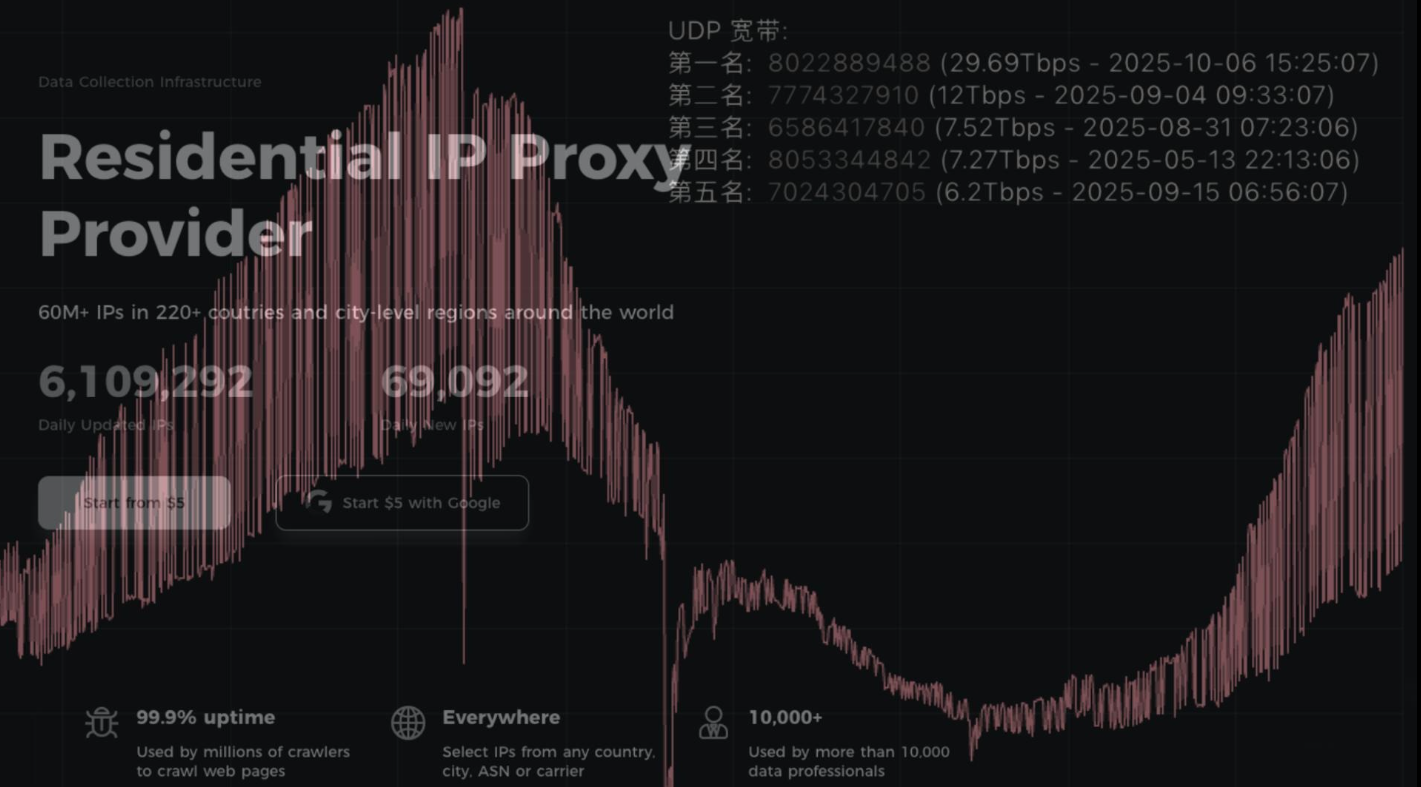
cybercriminals anonymize their traffic. Experts say a glut of proxies from Aisuru and other sources is fueling large-scale data harvesting efforts tied to various artificial intelligence (AI) projects, helping content scrapers evade detection by routing their traffic through residential connections that appear to be regular Internet users. First identified in August 2024, Aisuru has spread to at least 700,000 IoT systems, such as poorly secured Internet routers and security cameras. Aisuru’s overlords have used their massive botnet to clobber targets with headline-grabbing DDoS attacks, flooding targeted hosts with blasts of junk requests from all infected systems simultaneously. In June, Aisuru hit KrebsOnSecurity.com with a DDoS clocking at 6.3 terabits per second — the biggest attack that Google had ever mitigated at the time. In the weeks and months that followed, Aisuru’s operators demonstrated DDoS capabilities of nearly 30 terabits of data per second — well beyond the attack mitigation capabilities of most Internet destinations. These digital sieges have been particularly disruptive this year for U.S.-based Internet service providers (ISPs), in part because Aisuru recently succeeded in taking over a large number of IoT devices in the United States. And when Aisuru launches attacks, the volume of outgoing traffic from infected systems on these ISPs is often so high that it can disrupt or degrade Internet service for adjacent (non-botted) customers of the ISPs. “Multiple broadband access network operators have experienced significant operational impact due to outbound DDoS attacks in excess of 1.5Tb/sec launched from Aisuru botnet nodes residing on end-customer premises,” wrote Roland Dobbins, principal engineer at Netscout, in a recent executive summary on Aisuru. “Outbound/crossbound attack traffic exceeding 1Tb/sec from compromised customer premise equipment (CPE) devices has caused significant disruption to wireline and wireless broadband access networks. High-throughput attacks have caused chassis-based router line card failures.” The incessant attacks from Aisuru have caught the attention of federal authorities in the United States and Europe (many of Aisuru’s victims are customers of ISPs and hosting providers based in Europe). Quite recently, some of the world’s largest ISPs have started informally sharing block lists identifying the rapidly shifting locations of the servers that the attackers use to control the activities of the botnet. Experts say the Aisuru botmasters recently updated their malware so that compromised devices can more easily be rented to so-called “residential proxy” providers. These proxy services allow paying customers to route their Internet communications through someone else’s device, providing anonymity and the ability to appear as a regular Internet user in almost any major city worldwide. From a website’s perspective, the IP traffic of a residential proxy network user appears to originate from the rented residential IP address, not from the proxy service customer. Proxy services can be used in a legitimate manner for several business purposes — such as price comparisons or sales intelligence. But they are massively abused for hiding cybercrime activity (think advertising fraud, credential stuffing) because they can make it difficult to trace malicious traffic to its original source. And as we’ll see in a moment, this entire shadowy industry appears to be shifting its focus toward enabling aggressive content scraping activity that continuously feeds raw data into large language models (LLMs) built to support various AI projects. ‘INSANE’ GROWTH Riley Kilmer is co-founder of spur.us, a service that tracks proxy networks. Kilmer said all of the top proxy services have grown exponentially over the past six months — with some adding between 10 to 200 times more proxies for rent. “I just checked, and in the last 90 days we’ve seen 250 million unique residential proxy IPs,” Kilmer said. “That is insane. That is so high of a number, it’s unheard of. These proxies are absolutely everywhere now.” To put Kilmer’s comments in perspective, here was Spur’s view of the Top 10 proxy networks by approximate install base, circa May 2025: AUPROXIES_PROXY 66,097 RAYOBYTE_PROXY 43,894 OXYLABS_PROXY 43,008 WEBSHARE_PROXY 39,800 IPROYAL_PROXY 32,723 PROXYCHEAP_PROXY 26,368 IPIDEA_PROXY 26,202 MYPRIVATEPROXY_PROXY 25,287 HYPE_PROXY 18,185 MASSIVE_PROXY 17,152 Today, Spur says it is tracking an unprecedented spike in available proxies across all providers, including; LUMINATI_PROXY 11,856,421 NETNUT_PROXY 10,982,458 ABCPROXY_PROXY 9,294,419 OXYLABS_PROXY 6,754,790 IPIDEA_PROXY 3,209,313 EARNFM_PROXY 2,659,913 NODEMAVEN_PROXY 2,627,851 INFATICA_PROXY 2,335,194 IPROYAL_PROXY 2,032,027 YILU_PROXY 1,549,155 Reached for comment about the apparent rapid growth in their proxy network, Oxylabs (#4 on Spur’s list) said while their proxy pool did grow recently, it did so at nowhere near the rate cited by Spur. “We don’t systematically track other providers’ figures, and we’re not aware of any instances of 10× or 100× growth, especially when it comes to a few bigger companies that are legitimate businesses,” the company said in a written statement. Bright Data was formerly known as Luminati Networks, the name that is currently at the top of Spur’s list of the biggest residential proxy networks, with more than 11 million proxies. Bright Data likewise told KrebsOnSecurity that Spur’s current estimates of its proxy network are dramatically overstated and inaccurate. “We did not actively initiate nor do we see any 10x or 100x expansion of our network, which leads me to believe that someone might be presenting these IPs as Bright Data’s in some way,” said Rony Shalit, Bright Data’s chief compliance and ethics officer. “In many cases in the past, due to us being the leading data collection proxy provider, IPs were falsely tagged as being part of our network, or while being used by other proxy providers for malicious activity.” “Our network is only sourced from verified IP providers and a robust opt-in only residential peers, which we work hard and in complete transparency to obtain,” Shalit continued. “Every DC, ISP or SDK partner is reviewed and approved, and every residential peer must actively opt in to be part of our network.” HK NETWORK Even Spur acknowledges that Luminati and Oxylabs are unlike most other proxy services on their top proxy providers list, in that these providers actually adhere to “know-your-customer” policies, such as requiring video calls with all customers, and strictly blocking customers from reselling access. Benjamin Brundage is founder of Synthient, a startup that helps companies detect proxy networks. Brundage said if there is increasing confusion around which proxy networks are the most worrisome, it’s because nearly all of these lesser-known proxy services have evolved into highly incestuous bandwidth resellers. What’s more, he said, some proxy providers do not appreciate being tracked and have been known to take aggressive steps to confuse systems that scan the Internet for residential proxy nodes. Brundage said most proxy services today have created their own software development kit or SDK that other app developers can bundle with their code to earn revenue. These SDKs quietly modify the user’s device so that some portion of their bandwidth can be used to forward traffic from proxy service customers. “Proxy providers have pools of constantly churning IP addresses,” he said. “These IP addresses are sourced through various means, such as bandwidth-sharing apps, botnets, Android SDKs, and more. These providers will often either directly approach resellers or offer a reseller program that allows users to resell bandwidth through their platform.” Many SDK providers say they require full consent before allowing their software to be installed on end-user devices. Still, those opt-in agreements and consent checkboxes may be little more than a formality for cybercriminals like the Aisuru botmasters, who can earn a commission each time one of their infected devices is forced to install some SDK that enables one or more of these proxy services. Depending on its structure, a single provider may operate hundreds of different proxy pools at a time — all maintained through other means, Brundage said. “Often, you’ll see resellers maintaining their own proxy pool in addition to an upstream provider,” he said. “It allows them to market a proxy pool to high-value clients and offer an unlimited bandwidth plan for cheap reduce their own costs.” Some proxy providers appear to be directly in league with botmasters. Brundage identified one proxy provider that was aggressively advertising cheap and plentiful bandwidth to content scraping companies. After scanning that provider’s pool of available proxies, Brundage said he found a one-to-one match with IP addresses he’d previously mapped to the Aisuru botnet. Brundage says that by almost any measurement, the world’s largest residential proxy service is IPidea, a China-based proxy network. IPidea is #5 on Spur’s Top 10, and Brundage said its brands include ABCProxy (#3), Roxlabs, LunaProxy, PIA S5 Proxy, PyProxy, 922Proxy, 360Proxy, IP2World, and Cherry Proxy. Spur’s Kilmer said they also track Yilu Proxy (#10) as IPidea. Brundage said all of these providers operate under a corporate umbrella known on the cybercrime forums as “HK Network.” “The way it works is there’s this whole reseller ecosystem, where IPidea will be incredibly aggressive and approach all these proxy providers with the offer, ‘Hey, if you guys buy bandwidth from us, we’ll give you these amazing reseller prices,'” Brundage explained. “But they’re also very aggressive in recruiting resellers for their apps.” A graphic depicting the relationship between proxy providers that Synthient found are white labeling IPidea proxies. Image: Synthient.com. Those apps include a range of low-cost and “free” virtual private networking (VPN) services that indeed allow users to enjoy a free VPN, but which also turn the user’s device into a traffic relay that can be rented to cybercriminals, or else parceled out to countless other proxy networks. “They have all this bandwidth to offload,” Brundage said of IPidea and its sister networks. “And they can do it through their own platforms, or they go get resellers to do it for them by advertising on sketchy hacker forums to reach more people.” One of IPidea’s core brands is 922S5Proxy, which is a not-so-subtle nod to the 911S5Proxy service that was hugely popular between 2015 and 2022. In July 2022, KrebsOnSecurity published a deep dive into 911S5Proxy’s origins and apparent owners in China. Less than a week later, 911S5Proxy announced it was closing down after the company’s servers were massively hacked. That 2022 story named Yunhe Wang from Beijing as the apparent owner and/or manager of the 911S5 proxy service. In May 2024, the U.S. Department of Justice arrested Mr Wang, alleging that his network was used to steal billions of dollars from financial institutions, credit card issuers, and federal lending programs. At the same time, the U.S. Treasury Department announced sanctions against Wang and two other Chinese nationals for operating 911S5Proxy. The website for 922Proxy. DATA SCRAPING FOR AI In recent months, multiple experts who track botnet and proxy activity have shared that a great deal of content scraping which ultimately benefits AI companies is now leveraging these proxy networks to further obfuscate their aggressive data-slurping activity. That’s because by routing it through residential IP addresses, content scraping firms can make their traffic far trickier to filter out. “It’s really difficult to block, because there’s a risk of blocking real people,” Spur’s Kilmer said of the LLM scraping activity that is fed through individual residential IP addresses, which are often shared by multiple customers at once. Kilmer says the AI industry has brought a veneer of legitimacy to residential proxy business, which has heretofore mostly been associated with sketchy affiliate money making programs, automated abuse, and unwanted Internet traffic. “Web crawling and scraping has always been a thing, but AI made it like a commodity, data that had to be collected,” Kilmer said. “Everybody wanted to monetize their own data pots, and how they monetize that is different across the board.” Kilmer said many LLM-related scrapers rely on residential proxies in cases where the content provider has restricted access to their platform in some way, such as forcing interaction through an app, or keeping all content behind a login page with multi-factor authentication. “Where the cost of data is out of reach — there is some exclusivity or reason they can’t access the data — they’ll turn to residential proxies so they look like a real person accessing that data,” Kilmer said of the content scraping efforts. Aggressive AI crawlers increasingly are overloading community-maintained infrastructure, causing what amounts to persistent DDoS attacks on vital public resources. A report earlier this year from LibreNews found some open-source projects now see as much as 97 percent of their traffic originating from AI company bots, dramatically increasing bandwidth costs, service instability, and burdening already stretched-thin maintainers. Cloudflare is now experimenting with tools that will allow content creators to charge a fee to AI crawlers to scrape their websites. The company’s “pay-per-crawl” feature is currently in a private beta, and it lets publishers set their own prices that bots must pay before scraping content. On October 22, the social media and news network Reddit sued Oxylabs (PDF) and several other proxy providers, alleging that their systems enabled the mass-scraping of Reddit user content even though Reddit had taken steps to block such activity. “Recognizing that Reddit denies scrapers like them access to its site, Defendants scrape the data from Google’s search results instead,” the lawsuit alleges. “They do so by masking their identities, hiding their locations, and disguising their web scrapers as regular people (among other techniques) to circumvent or bypass the security restrictions meant to stop them.” Denas Grybauskas, chief governance and strategy officer at Oxylabs, said the company was shocked and disappointed by the lawsuit. “Reddit has made no attempt to speak with us directly or communicate any potential concerns,” Grybauskas said in a written statement. “Oxylabs has always been and will continue to be a pioneer and an industry leader in public data collection, and it will not hesitate to defend itself against these allegations. Oxylabs’ position is that no company should claim ownership of public data that does not belong to them. It is possible that it is just an attempt to sell the same public data at an inflated price.” As big and powerful as Aisuru may be, it is hardly the only botnet that is contributing to the overall broad availability of residential proxies. For example, on June 5 the FBI’s Internet Crime Complaint Center warned that an IoT malware threat dubbed BADBOX 2.0 had compromised millions of smart-TV boxes, digital projectors, vehicle infotainment units, picture frames, and other IoT devices. In July, Google filed a lawsuit in New York federal court against the Badbox botnet’s alleged perpetrators. Google said the Badbox 2.0 botnet “compromised more than 10 million uncertified devices running Android’s open-source software, which lacks Google’s security protections. Cybercriminals infected these devices with pre-installed malware and exploited them to conduct large-scale ad fraud and other digital crimes.” A FAMILIAR DOMAIN NAME Brundage said the Aisuru botmasters have their own SDK, and for some reason part of its code tells many newly-infected systems to query the domain name fuckbriankrebs[.]com. This may be little more than an elaborate “screw you” to this site’s author: One of the botnet’s alleged partners goes by the handle “Forky,” and was identified in June by KrebsOnSecurity as a young man from Sao Paulo, Brazil. Brundage noted that only systems infected with Aisuru’s Android SDK will be forced to resolve the domain. Initially, there was some discussion about whether the domain might have some utility as a “kill switch” capable of disrupting the botnet’s operations, although Brundage and others interviewed for this story say that is unlikely. A tiny sample of the traffic after a DNS server was enabled on the newly registered domain fuckbriankrebs dot com. Each unique IP address requested its own unique subdomain. Image: Seralys. For one thing, they said, if the domain was somehow critical to the operation of the botnet, why was it still unregistered and actively for-sale? Why indeed, we asked. Happily, the domain name was deftly snatched up last week by Philippe Caturegli, “chief hacking officer” for the security intelligence company Seralys. Caturegli enabled a passive DNS server on that domain and within a few hours received more than 700,000 requests for unique subdomains on fuckbriankrebs[.]com. But even with that visibility into Aisuru, it is difficult to use this domain check-in feature to measure its true size, Brundage said. After all, he said, the systems that are phoning home to the domain are only a small portion of the overall botnet. “The bots are hardcoded to just spam lookups on the subdomains,” he said. “So anytime an infection occurs or it runs in the background, it will do one of those DNS queries.” Caturegli briefly configured all subdomains on fuckbriankrebs dot com to display this ASCII art image to visiting systems today. The domain fuckbriankrebs[.]com has a storied history. On its initial launch in 2009, it was used to spread malicious software by the Cutwail spam botnet. In 2011, the domain was involved in a notable DDoS against this website from a botnet powered by Russkill (a.k.a. “Dirt Jumper”). Domaintools.com finds that in 2015, fuckbriankrebs[.]com was registered to an email address attributed to David “Abdilo” Crees, a 27-year-old Australian man sentenced in May 2025 to time served for cybercrime convictions related to the Lizard Squad hacking group.
How the best security training programs build strong security culture by focusing on high-risk groups like developers, executives, finance pros and more.
Infamous botnets like Mirai are exploiting Web-exposed assets such as PHP servers, IoT devices, and cloud gateways to gain control over systems and build strength.
Africa becomes a proving ground for AI-driven phishing, deepfakes, and impersonation, with attackers testing techniques against governments and enterprises.
In two separate incidents this summer, hackers appearing to work from Russia used available assets to steal data from a large Ukrainian business services company and a local government agency, researchers say.
Officers from the Army and Air Force are under consideration to lead the NSA, and moves could be happening soon for other top jobs at the spy agency, sources tell Recorded Future News.
The government contractor Conduent informed multiple states this week that a cybersecurity incident in January exposed the information of more than 10 million people.
The attack, which is the second time the group has hit Russia’s agro industrial firms in recent months, coincided with preparations for the Russian agriculture forum scheduled for the end of the month in Moscow.
Following scrutiny over the safety of the technology for kids and teenagers, Character.AI on Wednesday said that as of next month people under 18 will not be able to use its chatbots.
An Irish human rights group submitted a formal complaint to the European Commission alleging that Ireland’s appointment of a former Meta lobbyist to its Data Protection Commission is illegal.
The former executive sold the trade secrets to a Russian cyber-tools broker that “publicly advertises itself as a reseller of cyber exploits to various customers, including the Russian government,” according to the Department of Justice.
Cybersecurity researchers have discovered a set of 10 malicious npm packages that are designed to deliver an information stealer targeting Windows, Linux, and macOS systems. "The malware uses four layers of obfuscation to hide its payload, displays a fake CAPTCHA to appear legitimate, fingerprints victims by IP address, and downloads a 24MB PyInstaller-packaged information stealer that harvests
Threat actors are actively exploiting multiple security flaws impacting Dassault Systèmes DELMIA Apriso and XWiki, according to alerts issued by the U.S. Cybersecurity and Infrastructure Security Agency (CISA) and VulnCheck. The vulnerabilities are listed below - CVE-2025-6204 (CVSS score: 8.0) - A code injection vulnerability in Dassault Systèmes DELMIA Apriso that could allow an attacker to
Artificial Intelligence (AI) is rapidly transforming Governance, Risk, and Compliance (GRC). It's no longer a future concept—it's here, and it's already reshaping how teams operate. AI's capabilities are profound: it's speeding up audits, flagging critical risks faster, and drastically cutting down on time-consuming manual work. This leads to greater efficiency, higher accuracy, and a more
BeyondTrust’s annual cybersecurity predictions point to a year where old defenses will fail quietly, and new attack vectors will surge. Introduction The next major breach won’t be a phished password. It will be the result of a massive, unmanaged identity debt. This debt takes many forms: it’s the “ghost” identity from a 2015 breach lurking in your IAM, the privilege sprawl from thousands of new
Organizations in Ukraine have been targeted by threat actors of Russian origin with an aim to siphon sensitive data and maintain persistent access to compromised networks. The activity, according to a new report from the Symantec and Carbon Black Threat Hunter Team, targeted a large business services organization for two months and a local government entity in the country for a week. The attacks
Cybersecurity researchers are calling attention to a spike in automated attacks targeting PHP servers, IoT devices, and cloud gateways by various botnets such as Mirai, Gafgyt, and Mozi. "These automated campaigns exploit known CVE vulnerabilities and cloud misconfigurations to gain control over exposed systems and expand botnet networks," the Qualys Threat Research Unit (TRU) said in a report
Cybersecurity researchers have flagged a new security issue in agentic web browsers like OpenAI ChatGPT Atlas that exposes underlying artificial intelligence (AI) models to context poisoning attacks. In the attack devised by AI security company SPLX, a bad actor can set up websites that serve different content to browsers and AI crawlers run by ChatGPT and Perplexity. The technique has been